Governance
Business conduct is a decisive factor in ensuring the long-term success of the TRATON GROUP. It significantly influences relationships with customers, employees, suppliers, and other stakeholders. Ethical and responsible corporate governance is therefore of paramount importance. The TRATON GROUP’s ongoing membership and active participation in initiatives such as Transparency International Deutschland e.V., UN Global Compact, German Institute for Compliance (Deutsches Institut für Compliance), and Alliance for Integrity (Allianz für Integrität) demonstrate its unwavering commitment to conducting business with integrity, ethics, and compliance.
The sustainability matters that were identified as material for TRATON in the context of business conduct are: corporate culture, corruption and bribery, protection of whistleblowers, and political engagement. For the topics of management of relationships with suppliers including payment practices, and animal welfare, no material impacts, risks, or opportunities were identified, hence the topics are not addressed further in this report.
Corporate culture
The TRATON GROUP regards its corporate culture as a vital foundation for success and a driver of fostering collaboration across the entire organization. The following table shows the material IROs related to corporate culture for TRATON.
Impacts, risks and opportunities related to corporate culture
| Sustainability matter | IRO category | Time horizon | Scope | Description |
|---|---|---|---|---|
| Corporate culture | Potential negative impact | Short-term | Own operations | Disengagement of employees, lack of employee empowerment and motivation, potential unethical behavior from weak corporate culture. |
| Risk | Short-term | Own operations and downstream | Reduced productivity, decreased efficiency, and higher employee turnover fostered by a negative corporate culture. | |
Approaches and policies
To maintain responsible business conduct and implement the sustainability strategy of TRATON in line with its corporate values, several Group policies guide the Group’s efforts. They all relate to both the risk described in the IRO table above and the potential negative impact.
The TRATON GROUP’s values and principles are anchored in the overarching Code of Conduct for Employees, which shapes the corporate culture. It covers a wide range of topics, including ethical leadership and prohibition of corruption, as well as TRATON’s corporate values. Detailed information on our Code of Conduct for Employees can be found in the section on Sustainability governance.
TRATON corporate culture frameworks
Three frameworks further shape our corporate culture: TRATON GROUP corporate values, TRATON GROUP thinking model, and TRATON GROUP shared leadership principles. Together they form a system in which all components are interdependent.
Policies addressing corporate culture
| Name of policy | Key contents and objective | Scope | Responsible organizational level and monitoring process | Availability of the policy for stakeholders |
|---|---|---|---|---|
| TRATON GROUP corporate values | The TRATON GROUP corporate values provide the framework for how business is conducted in the Group. This is based on the firm conviction that there is a close connection between the results and the way in which all employees, managers, and the Executive Board behave, think, and make decisions. That is why the TRATON GROUP is committed to five corporate values: Customer First, Respect, Team Spirit, Responsibility, and Elimination of Waste (see figure below). These values underline its purpose “Transforming Transportation Together. For a sustainable world“. Although the TRATON GROUP finds its strength in the different perspectives within the Group, it is crucial that the full business potential be achieved and that the Group leverage its advantages to create value for clients and society. Hence, the TRATON GROUP has stepped up collaboration between its brands through work groups to successfully implement its strategy and realize joint projects. | TRATON GROUP | The most senior level at the TRATON GROUP that is accountable for this policy is the Executive Board. The framework is reviewed and updated if necessary. |
Access via intranet and website For more details, see the ”Actions addressing corporate culture” table below under “Corporate value roll-out.” |
| TRATON GROUP thinking model | The TRATON GROUP thinking model is a framework that describes how everyone involved learns, adapts, and evolves. It connects the TRATON GROUP corporate values with the Group’s results — and back again — to create a real-time and relevant organizational learning system, as shown in the figure below. This ensures that everyone involved in the development of methods has the same vision, even if they are not in direct contact with each other. The TRATON GROUP thinking model not only links corporate values and results but also integrates principles and methods into the strategy. It describes how principles are translated into methods and how knowledge is learned and preserved within the Group. | TRATON GROUP | The most senior level at the TRATON GROUP that is accountable for this policy is the Executive Board. The framework is reviewed and updated if necessary. | Access via intranet |
| TRATON GROUP shared leadership principles | The TRATON GROUP shared leadership principles capture how TRATON regards great leadership. Principles are rooted in the Group’s corporate values because it matters how we achieve business results. Each leadership principle serves all TRATON GROUP corporate values and describes a core idea that shapes the methods, connections, and dependencies described at greater length in the thinking model. The shared leadership principles help to avoid misunderstandings and unnecessary conflicts by defining good leadership. By adhering to the shared leadership principles, employees follow certain standards and methods that strengthen the Group’s external image. TRATON pursues three leadership principles: (1) own today, shape tomorrow, (2) start with trust, build together, and (3) dare to try, manage the risk. The shared leadership principles were developed in 2024 and implemented through various communication measures within the Group brands. | TRATON GROUP | The most senior level at the TRATON GROUP that is accountable for this policy is the Executive Board. The framework is reviewed and updated if necessary. | Access via intranet |
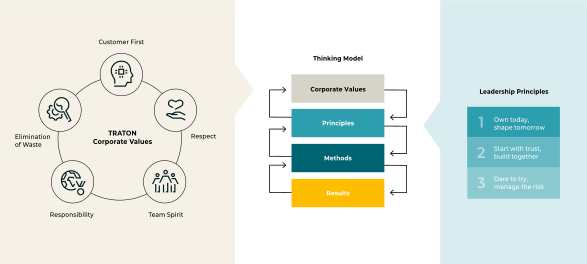
Actions
In 2025, the Group took several actions to engage the corporate culture. The key actions focus on the implementation of the corporate culture framework and are presented in the table below.
Actions addressing corporate culture
| Action | Description and time horizon | Scope | Target in place | Overall progress in 2025 and how we track effectiveness |
|---|---|---|---|---|
| Corporate value roll out | The TRATON GROUP is actively rolling out and strengthening its corporate values across all its brands, ensuring the seamless integration of these values throughout the organization. The implementation started in 2024 and continued in 2025. This is supported by a tool-based process, which consists of seven team sessions taking approximately ten hours per employee to complete. Each brand and Group function further needs to set up a system to implement the values in training, promotion schemes, and HR processes such as recruitment and similar to ensure that the corporate values are put into practice throughout the organization. The expected outcome is to support the development of the TRATON GROUP’s culture and to create awareness of the TRATON GROUP corporate values among all employees. | TRATON GROUP | See Role model Program in the section “Performance” below. | This will help shape actions and new behaviors that are aligned with the corporate values, ultimately contributing to a positive work environment and a strong Group culture. By November 2025 inclusive, 20,406 employees of TRATON GROUP (previous year: 12,672) had participated in the corporate value training. |
| Operationalization of The TRATON Way | In 2025, the TRATON GROUP initiated the operationalization of “The TRATON Way” across all brands and Group functions. These activities build on the TRATON GROUP Thinking Model, core values, and shared leadership principles, and aims to embed a shared mindset and way of working, enabling continuous improvement throughout the organization. The Executive Board endorsed four main principles “continuous improvements,” “right from me,” “normal situation,” and “demand driven” — as the foundation for this cultural alignment. Group functions were tasked with defining functional principles and visualizing their interpretation of “The TRATON Way” using a common shape and color scheme, while brands embarked on a validation journey to adapt and implement these principles. The initiative is coordinated by brand CEOs and functional leads. This cultural anchoring supports TRATON’s transformation goals and strengthens its identity as a unified yet diverse organization. | TRATON GROUP | No | The operationalization of “The TRATON Way” has led to increased clarity and consistency in decision-making and collaboration across functions. The definition of functional principles has been started in key areas such as HR, R&D, and Communications, and is being integrated into leadership development, onboarding, and change enablement programs. Effectiveness is tracked through feedback loops, workflow alignment sessions, and the adoption of shared practices in strategic projects. |
| Collaboration tools | Two tools are available to employees via the Group’s intranet: Team collaboration toolbox and culture kit. These tools serve as an implementation aid for corporate culture frameworks and are promoted throughout talent development programs, training, and working groups. | TRATON GROUP | No | The collaboration tools are continuously updated. |
| Change management | Good change management drives the TRATON strategy forward. Using change management for change initiatives embodies the TRATON GROUP core values, putting people in the center, and preparing the transformation. In 2025, a cross-brand working group aligned shared concepts, developed a joint training portfolio and a new change management page on the intranet The Tube. Implementation will continue in 2026. | TRATON GROUP | No | This will help shape actions and new behaviors that are aligned with the values and leadership principles, ultimately contributing to a positive work environment and a strong Group culture. |
| Tone from the top statements | Regular tone from the top statements addressing the Group’s own workforce by members of the Executive Board and management demonstrate the importance of compliance and commitment to ethical and compliant behavior. Such statements appear through various channels such as quotes in training and communication material and keynotes at compliance events. A clear tone from the corporate leadership encourages a compliance culture throughout the TRATON GROUP and demonstrates the commitment to internal and external stakeholders. | TRATON GROUP | No | |
Talent development programs
Another action significantly strengthening the application of the TRATON corporate values and beliefs reflected in the Group’s corporate culture are the talent development programs, which are described in the section on Own workforce.
Annual employee survey
In previous years, an annual employee survey called Stimmungsbarometer (StiBa) was conducted to obtain feedback on employees’ experiences and review how the corporate culture is developing. In the reporting year, this process was paused as the TRATON GROUP is developing and implementing a new employee survey process and tool called MyVoice, covering all brands. The new annual employee survey will help evaluate the success of business conduct implementation and serve to guide actions in the area of governance. In 2025, each TRATON brand decided on its own initiatives as the new MyVoice survey will be introduced in 2026.
Performance
In 2025, the following targets were set regarding corporate culture.
Role Model Program
The Role Model Program is based on TRATON’s corporate values and supports the culture change within the entire TRATON GROUP by reinforcing an open and trustful culture, as well as reducing silo thinking. For 2025, we set the target of a 75% implementation rate for the Role Model Program throughout the Group. The target was exceeded with a 76% (previous year: 82%) implementation rate. The targets are based on managers’ completion of their individual targets. Managers with a leadership function were required to set a good example by implementing at least two activities by the end of 2025 to reach 100%. Managers who made a status change in the second half of the year were only required to implement and document one activity in this timeframe. In total, 6,039 (previous year: 6,222) managers participated in the Role Model Program in 2025. Several functions from the TRATON GROUP’s People & Culture were involved in setting the targets, meaning that the Role Model Program is aligned with relevant policies, programs, and other goals of TRATON.
Prevention and detection of corruption and bribery
TRATON promotes ethical conduct and compliance across its own operations and value chain. This section outlines TRATON’s approach to preventing and detecting corruption and bribery, including relevant policies, training, and internal procedures that support transparency and integrity.
Impacts, risks and opportunities related to corruption and bribery
| Sustainability matter | IRO category | Time horizon | Scope | Description |
|---|---|---|---|---|
| Corruption and bribery | Potential negative impact | Short-term | Upstream, own operations, and downstream | Corruption can weaken governance, harm environmental initiatives, and foster unfair competition. |
Approaches and policies
The TRATON GROUP’s procedures to prevent, detect, and address allegations or incidents of corruption and bribery include, amongst others, the implementation of Group-wide policies (see Sustainability management process), conduct of due diligence checks (see Workers in the value chain), anti-corruption training and communications as described below, and the whistleblower system (see TRATON’s grievance mechanism). Furthermore, the TRATON GROUP Compliance department provides advice on compliance- and integrity-related questions, e.g., via the Compliance Helpdesk that employees can phone or email. Internal control systems (ICSs) are integrated into the business processes to help ensure that the TRATON GROUP’s financial and non-financial data is reliable, operations are effective and efficient, and activities comply with applicable laws and regulations. Findings from detective measures are used to identify additional preventive compliance measures. Furthermore, independence is assured as investigations are conducted by independent investigation offices and investigation units. The Chief Compliance Officer (CCO) of TRATON SE reports topics to the Compliance Board three times a year and to the Executive Board once a year. Further, the CCO reports quarterly to the Audit Committee.
Several policies manage the prevention and detection of corruption and bribery and relate to the potential negative impact of corruption, such as weakening governance, harming environmental initiatives, and fostering unfair competition. These policies are: Antitrust compliance, Business partner due diligence, Prevention of money laundering and terrorism financing, Donations and sponsoring, and Handling gifts, hospitality and invitations to events, and conflicts of interest. Further, the Code of Conduct for Employees, Code of Conduct for Suppliers and Business Partners (see Sustainability governance) and Internal investigations (see TRATON’s grievance mechanism) also relate to this IRO.
Policies addressing corruption and bribery
| Name of policy | Key contents and objective | Scope | Responsible organizational level and monitoring process | Availability of the policy for stakeholders |
|---|---|---|---|---|
| Antitrust compliance | Antitrust laws protect free and fair competition, thus preventing anti-competitive practices to the detriment of customers and other market participants. Hence, the TRATON GROUP commits itself without restriction to free and fair competition and does not tolerate violations of antitrust regulations. For this reason, the Antitrust compliance policy has been developed. It provides guidelines on how to address relevant areas in terms of antitrust regulations, when interacting with competitors, customers, and suppliers, and in cases where a company dominates the market. The Compliance department at TRATON is responsible for conducting training and other awareness measures, addressing questions related to the policy, and providing advice on potential antitrust infringements. In addition, the Legal department provides legal advice, particularly in the course of merger control proceedings. | TRATON GROUP | The most senior level at the TRATON GROUP that is accountable for this policy is the Executive Board. The policy is reviewed and updated if necessary. | Access via intranet and communicated in compliance training |
| Business partner due diligence (Group policy) | The TRATON GROUP strives to work with partners that follow the same high ethical principles of conduct to which we adhere. The Business partner due diligence policy relates to the risk of working with business partners lacking integrity by providing guidance on engaging with business partners, evaluating third parties using the business partner approval tool, concluding contracts, documenting, and archiving information, and establishing payment and remuneration frameworks. The policy governs the mandatory use of the Business Partner Approval Tool (BPA Tool), a web-based application that supports the assessment of the business partner’s integrity and provides approval workflows. The effectiveness of the policy is reviewed via quality assessments of due diligence checks conducted in the BPA Tool. Additionally, internal controls check whether all business partner contracts have gone through the due diligence process. The policy applies to the engagement of business partners that have an intermediary and representative function. This includes importers, dealers, resellers, authorized service partners, bodybuilders, and many more. The same rules for checking the integrity of these business partners are valid for all TRATON GROUP entities. The business partner’s integrity check utilizes the Corruption Perception Index (CPI), created by Transparency International. | TRATON GROUP | The most senior level at the TRATON GROUP that is accountable for this policy is the Executive Board. The policy is reviewed and updated if necessary. | Access via intranet and communicated in compliance training |
| Prevention of money laundering and terrorism financing (Group policy) | This Policy describes measures to prevent money laundering and terrorist financing as required by international applicable money laundering regulations. It further defines roles and responsibilities, explains red flags and the prohibition of cash payments above a certain threshold as well as obligations in the event of any suspicion of money laundering or terrorism financing. In case a TRATON GROUP employee becomes suspicious of any potential or factual money laundering in connection with a transaction or business relationship, the employee must report this immediately to the Compliance department responsible. It assesses the facts of the case, if necessary, with the support of the TRATON GROUP employee responsible, and decides whether there is indeed suspected money laundering. If required, the Compliance department ensures that the relevant authorities and the relevant stakeholders are informed accordingly. In addition, the TRATON GROUP employee is informed of the outcome of the analysis and advised on the next steps, if appropriate. | TRATON GROUP | The most senior level at the TRATON GROUP that is accountable for this policy is the Executive Board. The policy is reviewed and updated if necessary. | Access via intranet and communicated in compliance training |
| Policy for donations and sponsorships | TRATON supports selected institutions and projects with donations and sponsoring measures. The Donations and sponsoring Group policy ensures that donations and sponsoring measures are implemented in line with applicable legal provisions and in compliance with the TRATON GROUP’s integrity standards by stating admissible areas of support, (in)admissible donations, and sponsoring measures as well as additional process rules and thresholds. This policy prohibits any financial or in-kind political contributions, whether direct or indirect. | TRATON GROUP | The most senior level at the TRATON GROUP that is accountable for this policy is the Executive Board. The policy is reviewed and updated if necessary. To monitor compliance with and effectiveness of the policy, benefits in the form of donations and sponsoring measures must be documented and archived by the responsible donations or sponsorship manager of the brands. | Access via intranet and communicated in compliance training |
| Policy for gifts, hospitality and invitations to events and conflicts of interest (Group policy) | This policy lays down binding instructions on how to handle benefits granted to natural persons or legal entities, including criteria for determining the appropriateness of benefits to prevent corrupt behavior. Furthermore, this policy establishes rules for handling conflicts of interests. While the policy applies to TRATON employees, it affects several stakeholders in the value chain such as business partners, suppliers, and customers. | TRATON GROUP | The most senior level at the TRATON GROUP that is accountable for this policy is the Executive Board. The policy is reviewed and updated if necessary. | Access via intranet and communicated in compliance training |
Actions
In 2025, the following action was taken in relation to the prevention of corruption and bribery.
Action addressing the prevention of corruption and bribery
| Action | Description and time horizon | Scope | Target in place | Overall progress in 2025 and how we track effectiveness |
|---|---|---|---|---|
| Compliance helpdesk | The Compliance helpdesk is a service accessible to all TRATON GROUP employees via phone and email, providing guidance on a variety of compliance-related inquiries, topics, and requests. These may pertain to questions or uncertainties regarding the Code of Conduct for Employees, the Policy on handling gifts, hospitality and invitations to events, and conflicts of interest, the Group policy on internal investigations, the Policy on antitrust compliance, and the Policy on the prevention of money laundering and terrorism financing, and other compliance topics. The Compliance helpdesk serves as a point of contact for two purposes: first, to address inquiries aimed at preventing policy violations, and second, to report potential misconduct by employees. In the latter scenario, the matter is referred to the TRATON Central Investigation Office. | TRATON GROUP | The target below related to the Code of Conduct training is connected to the compliance helpdesk. During the training, employees are informed of the service. | This is a recurring action. Quarterly management reports on the number and types of compliance-related inquiries across all compliance areas. |
Performance
In 2025, the following targets were set regarding the prevention and detection of corruption and bribery.
Code of Conduct training
To support employees in applying the Code of Conduct for Employees, Code of Conduct training is offered to all employees of the TRATON GROUP. All employees, except for production and service personnel, are required to complete a web-based training course. For this training, we aimed at a 100% completion rate throughout the reporting year.
In the reporting period, 80% (previous year: 94%1 ) of the target group completed the web-based training. The difference can be explained by regular employee turnover, i.e., employees joining and leaving during the training period, as well as the continuing transition to the newly created Group R&D department.
Anti-corruption training
All TRATON GROUP employees receive training on the Code of Conduct for Employees, which includes education on anti-corruption. In addition, all employees of the TRATON GROUP, except for production and service personnel, must complete the web-based anti-corruption training, which also includes specific anti-bribery content. The training program defines corruption in general and covers topics such as dealing with public officials, gifts, hospitality and invitations, donations and sponsorships, and conflicts of interest. Employees in the target group must complete the training every three years. The TRATON GROUP aims at a 100% completion rate of mandatory anti-corruption training. In 2025, 79% (previous year: 86%2 ) of employees in the target group completed anti-corruption training. The difference is primarily attributable to employee turnover and the transition to the newly created Group R&D department.
Further, the anti-money laundering and terrorism financing training is a web-based training program for employees who are exposed to higher money laundering risks and could become aware of suspicious transactions. These include employees involved in payment services or with direct contact to third parties. In a three-year interval, they are trained on the respective policy, the risks of money laundering, red flags, and how to act when they suspect money laundering. The TRATON GROUP aims at a 100% completion rate of mandatory anti-money laundering training. In 2025, 73% (previous year: 52%) of employees in the target group completed the training on money laundering and terrorism financing. The difference is primarily attributable to employee turnover and the transition to the newly created Group R&D department.
In addition to web-based training, the TRATON GROUP offers face-to-face compliance training on a risk-based approach. Participating in corruption training is mandatory for all levels. Board members and relevant management functions participate in an additional Code of Conduct for Employees training since they act as role models and are exposed to higher risks due to their responsibilities. The format is a one-off, face-to-face training session. Based on case studies, topics such as fair and free competition, gifts, hospitality, and invitations, conflicts of interest, donations, sponsoring, and charity, and human rights and environmental protection are discussed. The compliance training program including the anti-corruption training and related target have been discussed with the TRATON SE Works Council.
Metrics related to corruption or bribery
In 2025, no criminal convictions were identified within the TRATON GROUP for breaches of anti-corruption or anti-bribery laws. Convictions for corruption and bribery include criminal convictions of a legal entity within the TRATON GROUP. Therefore, the TRATON GROUP incurred no fines as part of convictions for a violation of corruption and bribery laws including anti-money laundering in 2025.
To continuously improve its framework for combating corruption and bribery, the TRATON GROUP is implementing targeted measures designed to prevent, detect, and effectively address potential risks. These include root cause analyses for identified violations as well as proactive modifications and optimizations of processes and standards.
TRATON’s grievance mechanism
TRATON provides centralized channels for employees and external stakeholders to report concerns related to ethical conduct, compliance, and human rights. Through the DMA, TRATON identified a potential positive impact related to the protection of whistleblowers.
Impacts, risks and opportunities related to the grievance mechanism
| Sustainability matter | IRO category | Time horizon | Scope | Description |
|---|---|---|---|---|
| Protection of whistleblowers | Potential positive impact | Short-term | Upstream and own operations | Implementing robust speak-up channels promotes trust and a transparent culture. |
Approaches and policies
Integrity and compliant conduct in line with applicable statutory regulations, internal policies, as well as the principles laid down in the Code of Conduct for Employees and the Code of Conduct for Suppliers and Business Partners are of the highest priority for the TRATON GROUP. To avoid potential violations by employees, suppliers, business partners, or other external parties related to TRATON, or minimize the possibility of violations, it is crucial to identify these at an early stage. That is why the TRATON GROUP maintains an independent, impartial, and confidential whistleblower system that provides multiple channels for employees, business partners, and external parties to report potential violations.
The potential positive impact that occurs when implementing robust speak-up channels within the Group relates to the Group internal investigations policy and the complaints procedure. They are implemented through two actions, in particular, the Speak up! whistleblower portal and regular internal and external compliance audits. The 100% participation rate of Code of Conduct for Employees training also relates to this impact and the general sustainability matter of protection of whistleblowers. The target and the associated action are described in the Prevention and detection of corruption and bribery section. In addition to the policies described in the table below, the Code of Conduct for Suppliers and Business Partners further regulates the protection of whistleblowers.
Policies addressing the grievance mechanism
| Name of policy | Key contents and objective | Scope | Responsible organizational level and monitoring process | Availability of the policy for stakeholders |
|---|---|---|---|---|
| Internal investigations (Group policy) |
The internal investigations policy regulates how hints regarding potential violations are handled. Violations are all intentional or negligent violations of regulations of applicable law (e.g., statutory laws, regulations) or internal regulations (especially violations of the Code of Conduct for Employees or employment contractual obligations) committed by employees in connection with, or based upon, their employment by the TRATON GROUP. It describes the TRATON GROUP’s commitment and process to consequently follow up on potential violations, such as corrupt behavior. Standards are set such as general procedural rules for implementing and executing internal investigation processes in the TRATON GROUP, and the competencies, responsibilities, and cooperation requirements to be established within the Group are defined. The TRATON Central Investigation Office or Brand Investigation Offices conduct an internal investigation. The effectiveness of the policy is measured via the tracking of incoming hints, regular reporting, audits, and through an IT-based case management system, which documents and archives hints on violations and their processing, including the results in compliance with relevant data protection regulations. |
TRATON GROUP | The most senior level at the TRATON GROUP that is accountable for this policy is the Executive Board. The policy is reviewed and updated if necessary. | Access via intranet |
| Complaints procedure | The TRATON GROUP’s complaints procedure is an important part of safeguarding the corporate values and beliefs and serves to identify potential risks and violations to remedy them. It describes generally applicable principles for handling reports of potential risks or violations in the TRATON GROUP and across the associated supply chains. Anyone within the TRATON GROUP and along its supply chain can submit a report or complaint about potential risks or violations. The TRATON Central Investigation Office and the Brand Investigation offices operate the internal and external reporting channels. The TRATON GROUP ensures that reports of potential violations by TRATON GROUP employees and business partners along the supply chain are handled properly. | TRATON GROUP | The effectiveness of the complaints procedure is measured via the tracking of incoming hints, regular reporting, and audits. The Head of Investigations at TRATON SE is responsible for the implementation of the policy. | Accessible via the website. The complaints procedure aligns with internationally recognized instruments by complying with the legal requirements for a whistleblower system in accordance with the EU Whistleblower Protection Act. |
Actions
In 2025, the following action was implemented regarding TRATON’s grievance mechanisms.
Whistleblower portals
The TRATON GROUP whistleblower portal Speak Up! is accessible 24/7 in several languages for whistleblowers of the TRATON GROUP workforce to report any potential violations e.g., white-collar crime, corruption, antitrust law, and data protection concerns. It also allows for reporting of violations and risks related to human rights and environmental obligations, as well as other internal and statutory regulations. Besides, the whistleblower portal can be used by workers, direct, indirect suppliers, and affected communities to report violations of the Code of Conduct for Suppliers and Business Partners as well as violations of environmental laws and human rights. Even if the reporters’ preferred language is not offered in the reporting channel, whistleblowers can use any language to submit their report. The whistleblower portal is operated by a third party, which hosts the portal on external, certified servers, allowing whistleblowers to address hints to the company on an anonymous, non-traceable basis. Besides the electronic Speak Up! whistleblower portal, internal or external reports of misconduct can be directed towards the contacts within the TRATON Central Investigation Office by post or email, the 24/7 Volkswagen whistleblower hotline, and the ombudspersons of the Volkswagen Group.
After receiving a tip-off, the TRATON Central Investigation Office checks whether it is well-founded. It categorizes the tip-off according to its severity and, if appropriate, launches an investigation. It is dedicated to investigating potentially serious violations that could significantly impact the interests of the TRATON GROUP, particularly in terms of reputation or financial interests, or that could significantly violate the ethical values of the TRATON GROUP or one of its brands. In the event of a confirmed serious violation, the TRATON Central Investigation Office will present the outcome, along with appropriate disciplinary measures, to a Disciplinary Committee consisting of several functions. The Disciplinary Committee is chaired by the Chief Compliance Officer of TRATON SE and further comprises the Chief Human Resources Officer, the Chief Audit Executive, and the HR Coordinator of TRATON SE for cases concerning employees of TRATON SE. For cases concerning employees of a TRATON GROUP brand, the Brand Chief Executive Officer, Brand Chief Human Resources Officer, and Brand Chief Compliance Officer of the brand are included. Furthermore, the Head of the TRATON Central Investigation Office provides reports to the TRATON Chief Compliance Officer on selective cases on a regular basis and as needed.
The whistleblower system is designed to protect whistleblowers, the persons concerned, and equivalent individuals. Equivalent individuals are all persons who confidentially support a whistleblower in reporting a hint in a work-related context, individuals who are related to the whistleblower, and who may suffer retaliation in a work-related context. Discrimination against them is itself considered a serious violation. The investigation process is based on procedural principles, which include confidentiality, the need-to-know principle, and objectivity. The presumption of innocence applies to all persons concerned, as defined in the Internal Investigations Policy. The policy explicitly addresses the prohibition of any form of retaliation against whistleblowers, ensuring their protection throughout the investigation process.
Information about the whistleblower system is available on both the TRATON GROUP website and intranet. Regular and engaging communication measures and initiatives are carried out to raise awareness. In addition, TRATON conducts training sessions that are obligatory for all employees, including Executive Board members, and cover information on the TRATON GROUP whistleblower system (see Prevention and detection of corruption and bribery). Specialized training is available for key contact points (KCPs) of the whistleblower system. These KCPs are departments that potentially encounter the process of reporting, investigating, and sanctioning employee misconduct.
Actions related to TRATON’s grievance mechanism
| Action | Description and time horizon | Scope | Target in place | Overall progress in 2025 and how we track effectiveness |
|---|---|---|---|---|
| Regular internal and external compliance reports | To help ensure compliance with corporate governance, while also increasing corporate transparency and accountability across the TRATON GROUP, regular internal reporting related to GRC is provided to various boards and committees, including the Audit Committee of the Supervisory Board, Executive Board, Compliance Board, Human Rights Committee, and Sustainability Board. External GRC-related reporting is also conducted, such as communication on TRATON’s website, reports to relevant authorities and to the TRATON GROUP’s investors. GRC-related reporting is submitted via the digital compliance reporting tool of Volkswagen. | TRATON GROUP | No | This is a recurring action. |
Political engagement
Through the DMA, the following material impacts related to political engagement were identified by TRATON:
Impacts, risks and opportunities related to political engagement
| Sustainability matter | IRO category | Time horizon | Scope | Description |
|---|---|---|---|---|
| Political engagement | Potential negative impact | Long-term | Downstream | Possible impairment of sound decision-making due to opaque or questionable political influence |
| Potential positive impact | Long-term | Downstream | Support for a vibrant democracy and informed decision-making through transparent political influence. | |
Approaches and policies
The policies TRATON Code of Conduct for Employees, Donations and sponsoring, Public Affairs One-Voice Policy and State Aid – Europe, as well as Handling gifts, hospitality and invitations to events, and conflicts of interest, relate to both potential impacts described in the table above. There is no process in place for tracking these policies’ effectiveness as violations of the policy would be handled in the regular compliance and investigation processes described throughout this section. These were discussed in the previous section.
Policy addressing political engagement
| Name of policy | Key contents and objective | Scope | Responsible organizational level and monitoring process | Availability of the policy for stakeholders |
|---|---|---|---|---|
| Public affairs one-voice-policy and state aid — Europe (Group policy) |
This policy explains the fundamental procedure of the work process between the TRATON Public Affairs department, the brands, and TRATON entities. Regarding handling public affairs in the Group, the TRATON brands act independently and on their own responsibility but aligned with the TRATON Public Affairs department according to the policy. The key content of the policy includes a framework for lobbying, the One-Voice policy, the dotted line principle, an explanation of Group relevance, as well as principles and obligations that the TRATON GROUP and its brands must follow. Additionally, the application and handling process of the state aid and grant register is addressed and explained. Regarding the state aid and grant register, TRATON Public Affairs reports directly to the Volkswagen Group Public Affairs department, which then prepares an annual report on the state aid and grant register applied for and received in the EU by the Volkswagen Group and its brands and entities. The necessary data is provided by state aid coordinators or parties responsible for installing adequate processes for the appropriate and proper application and handling of the state aid and grant register. Furthermore, the Volkswagen Group Public Affairs department must be informed about the relevant activities of the brands and entities to support the implementation of suitable processes. To identify and track risks arising from the receipt of the state aid and grant register, brands and entities are obliged to maintain processes to identify and avoid project-specific risks. In the event of imminent reputational damage or legal consequences for TRATON GROUP or the Volkswagen Group, coordination with the departments of Volkswagen Group Public Affairs and TRATON Public Affairs takes place at an early stage. |
TRATON GROUP | The most senior level at the TRATON GROUP that is accountable for this policy is the Executive Board. The policy is reviewed and updated if necessary. | Access via intranet |
Actions
In 2025, the following actions were related to TRATON’s political engagement. Regarding the sustainability matter of political engagement, no relevant actions or targets are reported for 2025 as the potential impacts are already well regulated by TRATON GROUP policies and procedures, as well as by the legislation to which the Group adheres strictly.
Action related to political engagement
| Action | Description and time horizon | Scope | Target in place | Overall progress in 2025 |
|---|---|---|---|---|
| Chairmanship of ACEA Commercial Vehicles Board 2025 |
The TRATON GROUP actively contributes to shaping the sustainable transformation of the European transportation sector through industry collaboration. In 2025, Christian Levin, CEO of TRATON SE, was elected Chair of the ACEA Commercial Vehicles Board, strengthening TRATON’s role and visibility within the European automotive industry. This chairmanship provides an opportunity to advance TRATON’s ambition to drive the shift towards sustainable and innovative transportation solutions and to represent the Group’s perspectives in alignment with the TRATON One-Voice Policy. The engagement supports transparent and responsible dialog with EU policymakers and stakeholders on key topics such as decarbonization, electrification, and fair market conditions. |
ACEA is focused on the European market. | No target has been set because it is currently not possible to define a meaningful and measurable target due to the qualitative nature of this topic. | In the course of its chair activities in 2025, TRATON defined key focus areas and initiated coordination with ACEA working groups. Internally, the TRATON GROUP coordinated across brands and functions to set its own priorities. |
| Steering TRATON Public Affairs through the One-Voice Policy | In 2025, TRATON strengthened internal coordination between the Group Public Affairs department and the brands to ensure consistent representation of Group positions in political and regulatory discussions. The One-Voice Policy served as the guiding framework to align priorities, messaging, and stakeholder engagement activities across all brands. Regular coordination meetings and strategic alignment sessions were held to enhance transparency and coherence in external advocacy efforts. | TRATON GROUP | No target has been set because it is currently not possible to define a meaningful and measurable target due to the qualitative nature of this topic. | Ongoing alignment activities and structured coordination processes implemented across brands to reinforce unified representation in public affairs. |
Political influence and lobbying activities
All political engagement is conducted in accordance with the TRATON GROUP’s strategy and values, with integrity, transparency, and compliance given high priority. TRATON SE is listed in the German lobby register for the representation of interests vis-à-vis the German Parliament and the Federal Government under registration number R001565. Comparable transparency requirements are also complied with in other jurisdictions. TRATON SE engages in transparent, responsible dialog with political and administrative decision-makers at European, national, and regional level, as well as with relevant stakeholder groups. The aim of this engagement is to monitor regulatory and political developments, contribute relevant expertise where appropriate, and ensure coordinated and consistent representation of the Group’s interests. Activities within TRATON SE focus on coordination, governance, and harmonization within the Group. This includes ensuring a uniform corporate image, fostering the exchange of information between the Group and its brands, and ensuring compliance with applicable laws, transparency regulations, and internal policies. Responsibility for the content of technical, regulatory, or political positions lies with the relevant Group functions and brands. The TRATON GROUP’s responsibilities for monitoring lobbying activities are set out in the TRATON Code of Conduct for Employees and other Group policies (handling donations and sponsorship activities, public affairs One Voice policy, and state aid — Europe, as well as handling gifts, hospitality and invitations to events, and conflicts of interest). The Executive Board is responsible for approving these regulations. Since the Handling of donations and sponsoring measures policy of TRATON (see the table on Policies addressing corporate culture) does not allow political donations, the amount of political contributions (monetary and in-kind) made in 2025 was €0.