Report on Economic Position
1. Macroeconomic environment
Developments in the global economy
The global economy continued to grow in 2025, at a similar pace to the previous year. In the context of this development, a slight increase in momentum was observed in the emerging economies, whereas in the advanced economies it remained broadly unchanged from the previous year. Inflation rates declined in many countries, but remained at elevated levels in some countries. Due to these differing conditions, not all central banks reduced their key interest rates to the same extent. Overall, geopolitical uncertainties, particularly in connection with the economic policy stance of the US and the increase in geoeconomic measures, weighed on the global economic environment.
Europe
The Western European economy recorded positive growth overall in the reporting period, above the previous year’s level. Developments varied in the individual countries of Northern and Southern Europe. With inflation rates dropping, the European Central Bank cut its key interest rates in three steps starting in June 2024.
Economic growth: GDP change (in %)
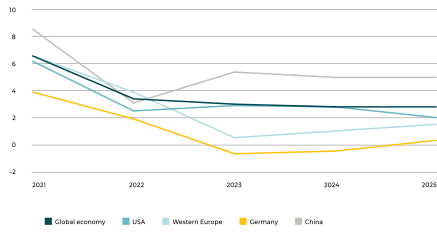
In 2025, the economies of Central Europe recorded overall growth that was slightly higher on average than in the same period of the previous year, while Eastern Europe experienced a smaller increase.
Germany
German gross domestic product stalled at the previous year’s level in 2025, after declining in each of the two preceding years. Compared with 2024, the unemployment rate rose somewhat on average over the year as a whole. The harmonized inflation rate in the reporting period was slightly below the previous year’s level.
North America
US gross domestic product grew at a somewhat slower rate in the reporting period than in the previous year. The US Federal Reserve had lowered its key interest rates in several steps in the previous year, but interrupted this easing cycle during the reporting year due to the uncertain effects of the new US administration’s economic policies, and did not resume monetary easing until September 2025. Canada and Mexico both recorded slightly lower economic growth than a year earlier.
South America
In Brazil, economic output grew at a slightly slower pace, while central bank interest rates rose. By contrast, economic growth in Argentina increased distinctly after two consecutive years of negative development.
Asia/Pacific
Growth in Chinese economic output exceeded the global average and remained approximately at the previous year’s level in the reporting period.
2. Exchange rates
Significant foreign currencies
| Average rate for the year | Year-end closing rate | |||
| 2025 | 2024 | 2025 | 2024 | |
| BRL/EUR | 6.3077 | 5.8262 | 6.4350 | 6.4314 |
| GBP/EUR | 0.8567 | 0.8467 | 0.8731 | 0.8302 |
| MXN/EUR | 21.6764 | 19.8219 | 21.1008 | 21.5892 |
| SEK/EUR | 11.0640 | 11.4329 | 10.7997 | 11.4501 |
| USD/EUR | 1.1297 | 1.0820 | 1.1748 | 1.0410 |
The euro appreciated against the US dollar and sterling on average over the year in 2025. The euro depreciated slightly against the Swedish krona on average over the year. Mexican pesos and Brazilian reais were weaker against the euro on average over the year than in 2024.
3. Market environment
The most important truck and bus markets (> 6t) for the TRATON GROUP are the EU27+3 region (European Union, the United Kingdom, Norway, Switzerland), the North America region (the USA, Canada, and Mexico), and South America. In North America, the truck market is divided into weight Classes ranging from 1 through 8. The market relevant for International is the Class 6–8 segment. This corresponds approximately to weight class > 9t.
In 2025, the TRATON GROUP’s most important truck markets (> 6t) reported an overall noticeable decline in demand. Following a slight decline in 2024, new truck registrations in the EU27+3 region fell noticeably year-on-year. The weakness of the construction sector and manufacturing industry continued to be a key factor in the ongoing reluctance to spend. Most countries in this region saw a decline, although it varied from country to country. For example, the United Kingdom and France recorded a noticeable decline. In Germany, the market losses were even more pronounced than in most of its neighboring countries. Conversely, a number of Eastern European EU countries recorded an increase in new registrations.
There was also a significant decline in demand in North America in 2025. Demand for heavy trucks in particular was impacted by the ongoing recession in freight transportation and increasing uncertainties surrounding trade policy, especially the new tariffs. New truck registrations in the USA/Canada were down significantly year-on-year, while the market in Mexico declined very sharply.
By contrast, the South American truck market continued its recovery from the previous year and grew slightly again in 2025. Whereas the economic situation in Brazil and thus also the truck market there weakened, the other countries in the region more than offset this decline.
The TRATON GROUP’s most important bus markets recorded noticeable growth compared with the previous year. In the EU27+3 region, new bus registrations in 2025 were significantly higher than in the previous year, although the trend varied in the individual countries. The North American market grew slightly year-on-year. The positive trend continued in South America, where the market grew noticeably.
4. Results of operations
Incoming orders and unit sales
Incoming Orders and Unit Sales by Country, TRATON Operations
| Units | Incoming orders | Unit sales | ||||
|---|---|---|---|---|---|---|
| 2025 | 2024 | Change | 2025 | 2024 | Change | |
| Total | 281,325 | 263,575 | 7% | 305,486 | 334,215 | –9% |
| of which all-electric vehicles | 2,823 | 3,851 | –27% | 3,226 | 1,739 | 86% |
| BEV unit sales ratio (excluding MAN TGE vans, in %) | – | – | – | 1.2 | 0.5 | 0.6 pp |
| Trucks | 224,243 | 208,519 | 8% | 239,783 | 278,130 | –14% |
| EU27+3 | 106,034 | 77,991 | 36% | 103,870 | 104,521 | –1% |
| of which in Germany | 26,492 | 20,145 | 32% | 26,816 | 26,904 | 0% |
| North America | 37,098 | 48,193 | –23% | 50,937 | 82,198 | –38% |
| in the USA/Canada | 30,486 | 38,930 | –22% | 43,779 | 66,354 | –34% |
| in Mexico | 6,612 | 9,263 | –29% | 7,158 | 15,844 | –55% |
| South America | 53,575 | 59,086 | –9% | 57,767 | 62,257 | –7% |
| of which in Brazil | 40,047 | 49,152 | –19% | 44,071 | 52,300 | –16% |
| Other regions | 27,536 | 23,249 | 18% | 27,209 | 29,154 | –7% |
| Buses | 27,932 | 32,235 | –13% | 34,359 | 28,413 | 21% |
| EU27+3 | 6,393 | 6,554 | –2% | 7,121 | 4,912 | 45% |
| of which in Germany | 1,610 | 1,485 | 8% | 1,689 | 895 | 89% |
| North America | 10,211 | 14,281 | –28% | 15,180 | 12,874 | 18% |
| in the USA/Canada | 9,158 | 11,357 | –19% | 13,606 | 9,711 | 40% |
| in Mexico | 1,053 | 2,924 | –64% | 1,574 | 3,163 | –50% |
| South America | 8,113 | 8,567 | –5% | 8,922 | 7,899 | 13% |
| of which in Brazil | 6,174 | 6,795 | –9% | 6,861 | 6,246 | 10% |
| Other regions | 3,215 | 2,833 | 13% | 3,136 | 2,728 | 15% |
| MAN TGE vans | 29,150 | 22,821 | 28% | 31,344 | 27,672 | 13% |
| EU27+3 | 28,390 | 22,400 | 27% | 30,572 | 27,239 | 12% |
| of which in Germany | 9,380 | 6,873 | 36% | 10,552 | 8,369 | 26% |
| Other regions | 758 | 421 | 80% | 770 | 433 | 78% |
Incoming orders were up noticeably on the previous year in the reporting year. The TRATON GROUP recorded a very strong increase in orders in the truck business in the EU27+3 region, primarily as a result of replacement demand following the reduction in the strong order book in the previous years. Customers in North America were still holding back due to uncertainty about the impact of US tariff policy and in the wake of the persistent recession in the freight market, which hurt incoming orders for trucks. The additional US tariffs on medium-duty and heavy-duty trucks, which came into force on November 1, 2025, as part of the Section 232 order, put additional pressure on incoming orders. In South America, a slowdown in momentum was observed in an increasingly challenging economic environment, which originated in Brazil in particular and was reflected in lower truck incoming orders across the entire region in the medium-duty and, above all, heavy-duty truck segments. Incoming orders for buses declined sizably, primarily in North America, mainly due to restrictive order acceptance in the middle of the year caused by limited capacity and a general reluctance to buy. Demand for the MAN TGE van rose sharply, partly as a result of the further expansion of the sales organization.
In a weak market environment characterized by uncertainty, unit sales were noticeably below the previous year’s level. In the EU27+3 region, unit sales were only down slightly year-on-year. The pace of growth improved gradually over the four quarters of 2025. For the reasons mentioned above, truck sales in North America were down very sharply year-on-year. South America experienced a noticeable decline in truck sales, primarily due to a slowdown in the Brazilian economy, rising interest rates, and high inflation. The bus business recorded a sharp increase in unit sales, after the previous year had been strongly impacted by the delayed ramp-up of the new school bus model at International, among other factors.
The book-to-bill ratio in the reporting period was 0.9 (previous year: 0.8).
1,281 (previous year: 430) all-electric trucks, 1,923 (previous year: 1,190) all-electric buses, and 22 (previous year: 119) MAN eTGE vans were sold in the reporting year.
Sales revenue
Sales revenue by product group
| € million | 2025 | 2024 | Change |
|---|---|---|---|
| TRATON GROUP | 44,052 | 47,473 | –7% |
| TRATON Operations | 42,536 | 46,182 | –8% |
| New Vehicles | 28,941 | 32,202 | –10% |
| Vehicle Services business1 | 8,742 | 8,751 | 0% |
| Others | 4,853 | 5,230 | –7% |
| TRATON Financial Services | 2,188 | 1,932 | 13% |
| Corporate Items | –672 | –642 | 5% |
1 Including genuine parts and workshop services
The TRATON GROUP’s sales revenue in the reporting year declined by €3.4 billion. This development is attributable primarily to the noticeable decline in unit sales and sales revenue for new vehicles at the TRATON Operations business area. The Vehicle Services business reported stable growth. The share of the Vehicle Services business in the sales revenue of the TRATON Operations business area rose from 18 to 21%. By contrast, the lower sales revenue for used and third-party vehicles led to a significant decline in other sales revenue. Sales revenue in the TRATON Financial Services segment increased by €256 million compared with the prior-year period. This was due primarily to an increase in portfolio volume, particularly in the wake of the expansion of the financial services business at MAN, and Volkswagen Truck & Bus.
Profit and loss
Condensed Income Statement of the TRATON GROUP
| € million | TRATON GROUP | TRATON Operations |
TRATON Financial Services |
Corporate Items | ||||
|---|---|---|---|---|---|---|---|---|
| 2025 | 2024 | 2025 | 2024 | 2025 | 2024 | 2025 | 2024 | |
| Sales revenue | 44,052 | 47,473 | 42,536 | 46,182 | 2,188 | 1,932 | –672 | –642 |
| Cost of sales | –35,630 | –37,373 | –34,678 | –36,499 | –1,491 | –1,315 | 539 | 440 |
| Gross profit | 8,421 | 10,100 | 7,858 | 9,684 | 696 | 617 | –133 | –202 |
| Distribution expenses | –3,835 | –3,813 | –3,282 | –3,320 | –311 | –243 | –242 | –249 |
| Administrative expenses | –1,645 | –1,710 | –1,484 | –1,478 | –30 | –47 | –130 | –184 |
| Other operating result | –515 | –368 | –347 | –285 | –188 | –122 | 20 | 38 |
| Operating result | 2,426 | 4,209 | 2,745 | 4,601 | 167 | 205 | –486 | –597 |
| Operating result (adjusted) | 2,773 | 4,384 | 3,092 | 4,776 | 167 | 205 | –486 | –597 |
| Operating return on sales (adjusted) (in %) | 6.3 | 9.2 | 7.3 | 10.3 | 7.6 | 10.6 | – | – |
| Financial result | –402 | –639 | –126 | –777 | 5 | 7 | –282 | 130 |
| Earnings before tax | 2,024 | 3,569 | 2,619 | 3,824 | 172 | 212 | –768 | –467 |
| Income taxes | –479 | –766 | –694 | –732 | –39 | –57 | 254 | 23 |
| Earnings after tax | 1,545 | 2,803 | 1,925 | 3,092 | 133 | 155 | –514 | –444 |
Operating result
The TRATON GROUP recorded a €1.7 billion or 17% decline in gross profit in the reporting year. Lower truck unit sales in the TRATON Operations business area were the major factor behind this decrease in gross profit. Gross profit was additionally impacted by decreased capacity utilization due to lower production volumes for heavy-duty trucks especially, expenses related to the termination of a development project in the USA as a result of delays in the pace of transition to battery-electric vehicles, and currency effects, primarily due to the appreciation of the Swedish kronor. Gross profit was also negatively impacted by higher expenses in connection with the start of production at the new plant in China in October 2025, the impact of the tariffs increased by the USA under Section 232, and effects related to the EU truck cases in individual countries. Gross margin decreased by 2.2 percentage points to 19.1% (previous year: 21.3%) in the TRATON GROUP and by 2.5 percentage points to 18.5% (previous year: 21.0%) in the TRATON Operations business area.
The TRATON GROUP’s distribution and administrative expenses were reduced by 1% year-on-year. The increase in distribution expenses in the TRATON Financial Services segment was primarily driven by new hires and largely offset by lower distribution expenses in the TRATON Operations business area. The ratio of distribution and administrative expenses to sales revenue rose by 0.8 percentage points to 12.4% (previous year: 11.6%), primarily because of the decline in sales revenue.
Other operating result decreased by €147 million compared with the prior-year level. The main drivers behind the decline were exchange rate losses, particularly from the valuation of foreign currency receivables, and higher expenses related to restructurings. Offsetting factors were currency gains, predominantly from the valuation of foreign currency liabilities, as well as positive effects from the measurement of derivatives.
Operating result was reduced by expenses of €173 million (previous year: €162 million) for civil lawsuits against Scania Vehicles & Services and MAN Truck & Bus in connection with the EU truck cases in individual countries, as well as restructuring expenses of €46 million (previous year: €14 million). In addition, expenses of €128 million were incurred in the year under review in connection with the termination of a BEV development project at International Motors. €100 million of this amount was attributable to the derecognition of capitalized development costs. Furthermore, US tariffs imposed under Section 232 had a €60 million negative impact on earnings.
Due to the effects described above, in particular because of the decrease in gross profit, the TRATON GROUP’s operating result in fiscal year 2025 decreased by €1.8 billion or 42% compared with the previous year.
Adjustments to operating result
| Adjustments (€ million) | 2025 | 2024 |
|---|---|---|
| Scania Vehicles & Services | 68 | 109 |
| legal proceedings and related measures | 26 | 101 |
| restructuring measures | 42 | 7 |
| MAN Truck & Bus | 151 | 66 |
| legal proceedings and related measures | 147 | 60 |
| restructuring measures | 4 | 6 |
| International Motors | 128 | – |
| termination of a development project for battery-electric vehicles | 128 | – |
| TRATON Operations | 347 | 175 |
| TRATON GROUP | 347 | 175 |
Adjustments in the TRATON Operations business area in the reporting year amounted to €347 million (previous year: €175 million). They were composed of the following items:
- Negative impact of €173 million (previous year: €162 million) in connection with civil lawsuits against Scania and MAN as a result of the EU truck cases in individual countries. They were calculated based on an updated risk assessment and including foreign exchange effects.
- Expenses of €128 million (previous year: €– million) relating to the termination of a BEV development project at International Motors.
- Expenses of €42 million (previous year: €7 million) for severance payments in connection with the restructuring of central functions at Scania Vehicles & Services. Expenses in the previous year related to the realignment of the Scania bus business.
- Expenses of €4 million (previous year: €6 million) for an internal reorganization at MAN Truck & Bus.
The TRATON GROUP’s operating result (adjusted) fell by €1.6 billion (37%) year-on-year. The TRATON GROUP’s operating return on sales (adjusted) declined by 2.9 percentage points to 6.3% (previous year: 9.2%). In the TRATON Operations business area, operating return on sales (adjusted) decreased by 3.1 percentage points to 7.3% (previous year: 10.3%).
Financial result
The TRATON GROUP’s financial result improved by €237 million compared with the prior-year figure. The main factors driving this increase were the absence of negative currency translation effects recorded in the previous year and lower interest expenses in the current reporting period. The TRATON Operations business area recorded a gain of €290 million from an adjustment of the ownership structure of the financial services business, although this was eliminated at the level of the TRATON GROUP.
Taxes
Income taxes decreased in 2025 by €287 million year-on-year, mainly due to earnings-related factors. The tax rate was up on the previous year, at 24% (previous year: 21%). Valuation allowances on tax loss carryforwards had a particularly negative impact on the tax rate. In the previous year, the tax rate had been reduced primarily by higher tax-exempt income.
Earnings after tax
Earnings after tax declined by €1.3 billion in the reporting year. For 2025, this resulted in a reduction in earnings per share by 45% to €3.09 (previous year: €5.61) per share. Calculation of earnings per share was still based on an average of 500 million shares.
Segments of the TRATON GROUP
Scania Vehicles & Services
| 2025 | 2024 | Change | |
| Incoming orders (units) | 92,351 | 81,012 | 14% |
| Sales (units) | 94,073 | 102,069 | –8% |
| of which trucks | 87,588 | 96,443 | –9% |
| of which buses | 6,485 | 5,626 | 15% |
| Book-to-bill ratio | 0.98 | 0.79 | 0.19 |
| Sales revenue (€ million) | 17,945 | 18,907 | –5% |
| New Vehicles | 11,696 | 12,883 | –9% |
| Vehicle Services business1 | 4,020 | 3,839 | 5% |
| Others | 2,230 | 2,185 | 2% |
| Operating result (adjusted) (€ million)2 | 1,926 | 2,801 | –875 |
| Operating return on sales (adjusted) (in %)2 | 10.7 | 14.8 | –4.1 pp |
1 Including genuine parts and workshop services
2 Prior-year figures adjusted, see the Financial management section
Scania Vehicles & Services recorded a significant year-over-year increase in incoming orders in 2025. A challenging environment in South America, especially Brazil, with substantial lower incoming orders was more than offset by a very strong increase in the EU27+3 region supported by a stronger sales execution in that region.
Truck unit sales fell noticeably compared to the good level of the previous year. In the EU27+3 region, the weak economic environment with a lack of growth impetus led to a slight decline. In Brazil, Scania Vehicles & Services experienced a very sharp decline in unit sales in a difficult market environment characterized by rising interest rates and high inflation. Bus unit sales rose substantially due to delayed deliveries in the previous year.
The overall decline in truck unit sales was the main reason for the moderate reduction in sales revenue, which mainly affected the New Vehicles business. This was only partially offset by the moderate growing Vehicle Services business.
The main driver of the decline in operating result (adjusted) was the volume-related decline in revenue. In addition, negative currency effects and higher expenses for the ramp-up of the new Chinese production site had a negative impact on operating result (adjusted).
MAN Truck & Bus
| 2025 | 2024 | Change | |
| Incoming orders (units) | 99,961 | 77,108 | 30% |
| Sales (units) | 101,642 | 96,037 | 6% |
| of which trucks | 63,296 | 63,655 | –1% |
| of which buses | 7,002 | 4,710 | 49% |
| of which MAN TGE vans | 31,344 | 27,672 | 13% |
| Book-to-bill ratio | 0.98 | 0.80 | 0.18 |
| Sales revenue (€ million)1 | 14,095 | 13,652 | 3% |
| New Vehicles | 8,783 | 8,383 | 5% |
| Vehicle Services business2 | 2,928 | 2,902 | 1% |
| Others1 | 2,384 | 2,367 | 1% |
| Operating result (adjusted) (€ million)1 | 904 | 919 | –15 |
| Operating return on sales (adjusted) (in %)1 | 6.4 | 6.7 | –0.3 pp |
1 Prior-year figures adjusted, see the Financial Management section
2 Including genuine parts and workshop services
MAN Truck & Bus recorded a very strong increase in incoming orders in 2025 compared with the prior-year figure. This was due in particular to a very strong increase in demand for trucks in the EU27+3 region. At the same time, demand for the MAN TGE van rose sharply, which is attributable, among other things, to the success of the business’s internationalization strategy.
Unit sales were up moderately year-on-year, primarily as a result of higher sales figures for buses and MAN TGE vans. Unit sales of trucks were marginally below the previous year’s level, but posted a slight increase in the EU27+3 region.
Sales revenue was up slightly year-on-year on the back of higher unit sales of new vehicles. This also reflected a shift in the product mix toward buses and the MAN TGE van. The Vehicle Services business delivered constant growth.
Operating result (adjusted) was slightly lower than in the previous year. The main reasons for this were a change in the product and regional mix and higher production costs.
International Motors
| 2025 | 2024 | Change | |
| Incoming orders (units) | 46,177 | 56,616 | –18% |
| Sales (units) | 63,732 | 90,562 | –30% |
| of which trucks | 50,112 | 79,300 | –37% |
| of which buses | 13,620 | 11,262 | 21% |
| Book-to-bill ratio | 0.72 | 0.63 | 0.10 |
| Sales revenue (€ million) | 8,169 | 11,116 | –27% |
| New Vehicles | 5,924 | 8,263 | –28% |
| Vehicle Services business1 | 1,645 | 1,860 | –12% |
| Others | 599 | 994 | –40% |
| Operating result (adjusted) (€ million)2 | 9 | 724 | –715 |
| Operating return on sales (adjusted) (in %)2 | 0.1 | 6.5 | –6.4 pp |
1 Including genuine parts
2 Prior-year figures adjusted, see the Financial management section
Demand in North America remained subdued in 2025, as tariff challenges and persistent weakness in the freight market led to a significant year over year decline in incoming orders at International Motors.
As a result, truck unit sales fell very sharply. Weaker demand in Mexico also had a negative impact, following the prior year’s temporary boost from Euro 5 prebuy effects. In contrast, bus sales increased compared with the previous year, as the first half of 2024 had been adversely affected by delays in ramping up the new school bus model.
The combination of soft demand and declining unit volumes led to a strong decrease in new vehicle sales as well as a significant drop in vehicle service revenues.
The negative earnings impact from lower unit sales on adjusted operating result could only be partially mitigated through reductions in product and fixed costs. Elevated tariff expenses further weighed on performance, resulting in only a slightly positive adjusted operating result.
Volkswagen Truck & Bus
| 2025 | 2024 | Change | |
| Incoming orders (units) | 42,988 | 48,865 | –12% |
| Sales (units) | 46,171 | 45,846 | 1% |
| of which trucks | 38,862 | 39,018 | 0% |
| of which buses | 7,309 | 6,828 | 7% |
| Book-to-bill ratio | 0.93 | 1.07 | –0.13 |
| Sales revenue (€ million) | 2,768 | 2,918 | –5% |
| New Vehicles | 2,549 | 2,698 | –6% |
| Vehicle Services business1 | 173 | 179 | –3% |
| Others | 46 | 42 | 10% |
| Operating result (adjusted) (€ million)2 | 323 | 346 | –23 |
| Operating return on sales (adjusted) (in %)2 | 11.7 | 11.9 | –0.2 pp |
1 Including genuine parts and workshop services
2 Prior-year figures adjusted, see the Financial management section
In 2025, Volkswagen Truck & Bus recorded a significant year-on-year decline in incoming orders compared with the previous year's figure in a market environment characterized by increased dealer inventories, high interest rates and inflationary pressure, especially in Brazil.
In 2025, truck unit sales were slightly above previous year's level. A decline in Mexico was fully offset by higher truck unit sales in markets such as Argentina, Chile and Colombia. In the core market of Brazil, truck sales for the year as a whole were on a level with the previous year, despite a slowdown in the second half of the year. Bus sales increased noticeably compared to the previous year.
Sales revenue was mainly impacted by currency effects and were moderately lower year-over-year.
This was also the main reason for the moderate decline in operating result (adjusted).
TRATON Financial Services
| 2025 | 2024 | Change | |
| Sales revenue (€ million) | 2,188 | 1,932 | 13% |
| Earnings before tax (€ million) | 172 | 212 | –40 |
| Equity (€ million)1 | 2,275 | 2,052 | 223 |
| Return on equity (in %) | 8.0 | 10.8 | –2.8 pp |
1 As of December 31
After acquiring the rights to the future MAN financial services business in several countries in the previous year, TRATON Financial Services fully completed its acquisition in the 1st half of 2025. As part of this expansion, the rights to the financial services business for MAN and Volkswagen Truck & Bus were acquired in additional countries, including Brazil, for a total purchase price of €72 million (previous year: €254 million).
In the TRATON Financial Services segment, sales revenue increased significantly, due to the continued growth in the portfolio. Portfolio expansion was primarily driven by additional financing volumes of MAN and Volkswagen Truck & Bus.
The ramp-up of financing activities in several new markets led to higher costs in 2025 that could not be offset by higher interest income from the increased portfolio volume. In addition, higher financing costs, impairments and derecognition of receivables, particularly in Brazil in the 4th quarter 2025, as well as increased competitive pressure, had a negative impact on earnings before tax.
At the end of 2025, TRATON Financial Services' equity increased by €223 million year-on-year to €2.3 billion, reflecting the continued strengthening of the capital base in line with portfolio growth. Intra-Group contributions of €161 million (previous year: €229 million) in the reporting period had an increasing effect on equity. This was partly offset by the difference between the consideration transferred and net assets at book value after deferred taxes of €43 million (previous year: €164 million), incurred in connection with the acquisition dates and offset against equity.
As a result of the lower earnings before tax during the ramp-up phase and the higher equity base, return on equity decreased.
5. Financial position
Principles and goals of financial management
Financial management contributes to the value of the TRATON GROUP by optimizing the outcome of all financing measures, liquidity and capital structure, and also by managing risks.
All external and internal financial transactions are solely generated to fulfill financing needs or to limit risks from an actual underlying business transaction and therefore do not serve any speculative purpose. Strong dependencies on particular financial partners are systematically avoided. All financial transactions are concluded under standard market conditions.
Financial management has the duty to manage all financial transactions and financial risks in the TRATON GROUP with a focus on achieving the following objectives:
- Ensuring the solvency of all Group companies at all times as well as the financing of all Group business activities
- Limiting of market price risks (from interest rates, foreign currencies/exchange rates, commodity prices) and default risk of financial counterparties
- Optimization of costs from funding activities and returns on financial investments
- Securely processing financial and payment transactions and pooling group liquidity
Financing strategy
It is the TRATON GROUP’s goal to finance ongoing investment requirements of the TRATON Operations business area including Corporate Items from operating cash flow. For this reason, the TRATON Operations business area, including Corporate Items, should not report any net financial debt in a normal business environment. Depending on the gearing ratio and the liquidity position, other capital spending projects, such as acquisitions, should be financed by a balanced mixture of equity and debt. The composition can be adapted to reflect the relevant capital market environment. TRATON strives to reduce net financial debt in the TRATON Operations business area, including Corporate Items, to zero by the end of the decade. In the TRATON Financial Services business area, it is ensured that leased or financed assets are financed at matching maturities.
As a general rule, the capital structure of the TRATON Operations business area including Corporate Items should correspond to an implied solid investment-grade classification. The net financial debt/EBITDA (adjusted) ratio is a key performance indicator in this context. If justified by extraordinary financing requirements or special market circumstances, this target can be temporarily relaxed subject to certain conditions. TRATON SE has been awarded external credit ratings by Moody’s and Standard & Poor’s (S&P) since June 2020. Moody’s is currently awarding a long-term rating of Baa2 (stable outlook), and S&P’s rating is BBB (negative outlook). Both ratings are investment-grade range.
Financing mix
Financial liabilities are intended to comprise a balanced mix of capital market financing, bank liabilities, the asset-backed securities (ABS) portfolios of the TRATON Financial Services segment, and other financing sources. No single source of financing should permanently exceed 60% of the total financing volume. It is intended to use a wide range of financing instruments for current financial liabilities in particular.
Liquidity
The TRATON GROUP strives to maintain adequate available liquidity from net cash flow in the TRATON Operations business area. In addition to TRATON’s access to the debt market, liquidity is supplemented by the syndicated revolving credit line and by credit lines from Volkswagen AG and banks, among others, to cover liquidity requirements at all times.
Maturity profile
The TRATON GROUP generally aims to achieve a balanced maturity profile for its liabilities so that it can cover amounts that fall due during the year from net cash flow to the greatest extent possible. To reduce funding risk in the TRATON Financial Services business area, the maturity profile should not be considerably shorter than the portfolio of underlying customer contracts.
Dividends policy
The TRATON GROUP intends to pay a dividend of 30 to 40% of its annual consolidated earnings after tax. The resolution to pay out a dividend for a particular fiscal year is adopted by the Annual General Meeting in the following year. The dividend is paid once a year. The proposal by the Executive Board and Supervisory Board concerning the amount of the dividend generally considers business performance and other influencing factors.
Risk management
TRATON operates an appropriate risk management system, including financial instruments such as derivatives, to hedge the Group’s financial risks, for example exchange rate risks or commodity price risks. Order book and other probable future sales and purchase contracts are partly hedged within defined limits. Commodity price risks are also partly hedged, while counterparty risks are closely monitored. Management of foreign currency, interest rate, and commodity exposure is not central but at the discretion of each brand. The relevant requirements of each company are considered since different functional currencies and business environments apply. The Group’s activities in the TRATON Financial Services business area are managed to largely match assets and liabilities in order to minimize interest rate mismatches using appropriate methods to manage risks.
Financing in 2025
Gross financial liabilities amounted to €27.4 billion (previous year: €24.3 billion) as of December 31, 2025. €17.1 billion (previous year: €15.3 billion) of this amount was attributable to capital market instruments, €6.4 billion (previous year: €5.4 billion) to bank funding, €2.6 billion (previous year: €2.4 billion) to Volkswagen Group loans, and €1.3 billion (previous year: €1.2 billion) to lease liabilities.
|
Financial liabilities of the TRATON GROUP as of 12/31/2025 € billion |
Carrying amount | Nominal value | ||||||
|---|---|---|---|---|---|---|---|---|
| Total | Total | Due 2026 | Due 2027 | Due 2028 | Due 2029 | Due 2030 |
Due 2031 or later |
|
| Bonds | 15.5 | 15.6 | 4.2 | 3.5 | 2.9 | 2.4 | 1.3 | 1.3 |
| of which for the financial services business | 12.9 | 4.1 | 3.5 | 2.4 | 1.1 | 1.3 | 0.5 | |
| Commercial paper | 1.2 | 1.2 | 1.2 | – | – | – | – | – |
| of which for the financial services business | 1.2 | 1.2 | – | – | – | – | – | |
| Liabilities to banks | 6.4 | 6.4 | 3.3 | 1.5 | 0.6 | 0.2 | 0.7 | – |
| of which for the financial services business | 2.9 | 1.3 | 0.9 | 0.4 | 0.2 | 0.1 | – | |
| Schuldscheindarlehen | 0.4 | 0.4 | 0.3 | – | 0.1 | – | – | – |
| of which for the financial services business | – | – | – | – | – | – | – | |
| Volkswagen Group liabilities | 2.6 | 2.6 | 1.2 | 0.7 | 0.7 | – | – | – |
| of which for the financial services business | 1.5 | 1.2 | 0.2 | – | – | – | – | |
| Total financial liabilities (excluding lease liabilities) | 26.1 | 26.2 | 10.3 | 5.7 | 4.3 | 2.6 | 2.0 | 1.3 |
| of which for the financial services business | 18.5 | 7.8 | 4.6 | 2.9 | 1.3 | 1.4 | 0.5 | |
| Lease liabilities¹ | 1.3 | 1.3 | ||||||
| Total financial liabilities | 27.4 | 27.5 | ||||||
| of which for the financial services business | 18.5 | |||||||
1 The maturity structure of the lease liabilities (IFRS 16 Leases) is as follows: < 1 year: €267 million; 1–5 years: €725 million; > 5 years: €283 million.
|
Financial liabilities of the TRATON GROUP as of 12/31/2024 € billion |
Carrying amount | Nominal value | ||||||
|---|---|---|---|---|---|---|---|---|
| Total | Total | Due 2025 | Due 2026 | Due 2027 | Due 2028 | Due 2029 |
Due 2030 or later |
|
| Bonds | 14.7 | 14.8 | 4.9 | 3.5 | 1.3 | 1.0 | 2.2 | 1.8 |
| of which for the financial services business | 10.9 | 3.8 | 3.3 | 1.3 | 0.5 | 1.0 | 1.0 | |
| Commercial paper | 0.2 | 0.2 | 0.2 | – | – | – | – | – |
| of which for the financial services business | 0.2 | 0.2 | – | – | – | – | – | |
| Liabilities to banks | 5.4 | 5.4 | 2.0 | 2.4 | 0.5 | 0.2 | 0.1 | 0.2 |
| of which for the financial services business | 2.5 | 1.3 | 0.5 | 0.4 | 0.2 | 0.1 | – | |
| Schuldscheindarlehen | 0.4 | 0.4 | – | 0.3 | – | 0.1 | – | – |
| of which for the financial services business | – | – | – | – | – | – | – | |
| Volkswagen Group liabilities | 2.4 | 2.4 | 0.9 | 0.6 | 0.6 | 0.3 | – | – |
| of which for the financial services business | 1.5 | 0.7 | 0.6 | 0.2 | – | – | – | |
| Total financial liabilities (excluding lease liabilities) | 23.1 | 23.2 | 7.9 | 6.8 | 2.5 | 1.7 | 2.3 | 2.0 |
| of which for the financial services business | 15.1 | 6.0 | 4.4 | 1.9 | 0.7 | 1.1 | 1.0 | |
| Lease liabilities1 | 1.2 | 1.2 | ||||||
| Total financial liabilities | 24.3 | 24.4 | ||||||
| of which for the financial services business | 15.1 | |||||||
1 The maturity structure of the lease liabilities (IFRS 16 Leases) is as follows: < 1 year: €254 million; 1–5 years: €698 million; > 5 years: €219 million.
Financing of the TRATON GROUP
The European Medium Term Notes program (EMTN program), which the TRATON GROUP has had since March 12, 2021, was updated on March 24, 2025, and increased from €12.0 billion to €18.0 billion. In addition to TRATON SE, the company’s indirect subsidiary TRATON Finance Luxembourg S.A., Strassen, Luxembourg (TRATON Finance) can also issue bonds under this program. The total principal amount of bonds as of December 31, 2025, was €11.6 billion (previous year: €10.8 billion), which were issued under the EMTN program by TRATON Finance. During the course of 2025, bonds with a principal amount of €2.9 billion were issued in euros, €773 million were issued in Swedish kronor, and €172 million in Swiss francs. The bonds issued under the EMTN program are hedged in part by interest rate derivatives. In addition, Scania is using a €5.0 billion EMTN program, of which a total principal amount of €289 million (previous year: €1.6 billion) had been drawn down as of year-end 2025. Since August 2025, TRATON has had an Australian Medium Term Notes program (AMTN program) with a volume of AUD 5.0 billion or approximately €2.8 billion. No bonds were issued under this program in fiscal year 2025.
Bonds from the EMTN program in the principal amount of approximately €9.1 billion (previous year: €7.3 billion) were used for financial services transactions. In addition, companies in the TRATON Financial Services segment issued bonds totaling €1.4 billion (previous year: €2.0 billion) as of December 31, 2025. In 2025, Scania Finance Southern Africa (Pty) Ltd., Johannesburg, South Africa, established a South African rand (ZAR) medium-term notes program with a volume of ZAR 10.0 billion, or approximately €515 million. Issuances under this program amounted to the equivalent of €288 million as of December 31, 2025. In addition, the TRATON Financial Services segment has bonds totaling €2.5 billion (previous year: €1.6 billion) from asset-backed securities transactions. The bonds, including asset-backed securities transactions for financial services transactions, increased by approximately €2.0 billion.
The TRATON GROUP’s drawdowns from the €2.5 billion commercial paper program (CP program) as of December 31, 2025, amounted to a principal amount of €1.2 billion (previous year: €189 million), which were issued by TRATON Finance and were used exclusively to finance the TRATON Financial Services segment. In addition to TRATON Finance, TRATON SE and TRATON Treasury AB, Södertälje, Sweden (TRATON Treasury AB) can also issue commercial paper under the CP program. The CP program covers the short-term financing requirements of the TRATON Financial Services segment. The short-term P-2 credit rating assigned by Moody’s and the A-2 rating assigned by S&P correspond to TRATON SE’s long-term investment-grade ratings.
The TRATON GROUP also had bank liabilities of €6.4 billion (previous year: €5.4 billion) as of December 31, 2025. Of this amount, €2.3 billion (previous year: €2.0 billion) were attributable to TRATON SE. TRATON SE repaid bank liabilities of €250 million prematurely over the course of 2025. In addition, €350 million in loan liabilities of TRATON SE were prolonged. As its only new bank loan, TRATON SE entered into a bilateral loan agreement with the European Investment Bank (EIB) on December 2, 2025, for up to €500 million to finance the costs of the TRATON Modular System project in the years 2025 to 2027. The entire loan amount was disbursed on December 19, 2025, with a term of five years. The TRATON SE also has €467 million (previous year: €483 million) in unused unconfirmed credit lines from banks at its disposal in order to enhance flexibility in financing decisions. In addition, TRATON SE’s financing using Schuldscheindarlehen as of December 31, 2025, remained unchanged at €350 million (previous year: €350 million).
Via TRATON SE, the TRATON GROUP has access to revolving credit lines of €4.3 billion (previous year: €4.3 billion) from Volkswagen AG, of which €250 million (previous year: €943 million) had been drawn down as of December 31, 2025, as well as a €681 million revolving credit line from Volkswagen Group of America Finance, LLC, Reston, USA, to Navistar Financial Corporation, of which €344 million (previous year: €95 million) had been drawn down as of December 31, 2025. Further, Navistar Financial Corporation took out a one-year loan of €128 million in December 2025. In addition to the loan of €339 million (previous year: €383 million) received in fiscal year 2024, International Motors took out a two-year loan of €127 million and a further three-year loan of €467 million from Volkswagen Group of America Finance, LLC, Reston, USA. The two loans, financed by Volkswagen International Finance N.V., Amsterdam, Netherlands in 2024 — one loan of €500 million with a term of two years and another loan of €191 million with a term of three years — remained unchanged as of December 31, 2025.
The TRATON GROUP also has an unused confirmed credit line of €4.5 billion (previous year: €4.5 billion) available as a liquidity reserve, which TRATON SE agreed with a banking consortium of 23 banks. After exercising both extension options, the revolving credit line has a total term of seven years and expires on December 16, 2028. The credit line serves general corporate purposes as well as to safeguard the TRATON GROUP’s liquidity.
In October 2025, the TRATON GROUP successfully introduced a Group-wide Green Finance Framework to support investments in battery-electric mobility. The Framework forms the basis for a wide range of green financing instruments, including green bonds, loans, Schuldscheindarlehen, and asset-backed securities. The TRATON GROUP received a second party opinion on this from S&P Global Ratings. The Framework was rated “Dark Green,” the highest possible category.
The broad range of funding contracts entail interest rates in keeping with market conditions, which differ according to the respective financial instrument, maturity, currency, funding purpose, volume, and region.
Financial liabilities of the TRATON GROUP by currency
| € billion | 12/31/2025 | 12/31/2024 |
|---|---|---|
| EUR | 15.1 | 14.4 |
| SEK | 3.1 | 2.8 |
| USD | 2.4 | 1.5 |
| BRL | 1.5 | 0.8 |
| GBP | 1.0 | 1.0 |
| MXN | 0.6 | 0.7 |
| CHF | 0.7 | 0.5 |
| ZAR | 0.4 | 0.4 |
| Other currencies | 1.4 | 0.8 |
| Lease liabilities | 1.3 | 1.2 |
| Total financial liabilities | 27.4 | 24.3 |
The TRATON GROUP’s credit facilities contain standard market change-of-control clauses. This means that the counterparty may demand early repayment in the event of significant changes in ownership. Two loans of a subsidiary of the TRATON GROUP used to develop and construct production and assembly facilities in China (China loans), with a total life of ten years each, include financial covenants. For loan liabilities with a carrying amount of €221 million (previous year: €308 million) as of December 31, 2025, the ratio of total liabilities to total assets of the subsidiary may not exceed 90%. For the second loan, which was refinanced in fiscal year 2025, the subsidiary’s net profit must be positive and the debt service coverage ratio may not fall below 1.2. The debt service coverage ratio describes the ratio between the subsidiary’s net profit before interest expenses attributable to the China loans and depreciation and amortization, to the principal amount, interest payments, and interest due on both China loans. The carrying amount of the loan as of December 31, 2025, is €395 million (previous year: €– million).
Liquidity
Cash and cash equivalents amounted to €2.8 billion (previous year: €2.5 billion) as of December 31, 2025. Cash and cash equivalents in certain countries (e.g., Brazil, China, and Argentina) in the amount of €736 million (previous year: €834 million) are subject to exchange controls and are not available to the Group for cross-border transactions without restriction. Such amounts are used locally to cover the financing needs of the operating business.
€103 million (previous year: €120 million) was reported in other financial assets as restricted cash as of December 31, 2025. This is mainly used as collateral in asset-backed securities transactions. In the previous year, restricted cash included an additional €41 million for the gradual acquisition of key aspects of the global financial services businesses of MAN and VWTB.
The TRATON GROUP’s financial management manages cash pool structures at brand level, wherever legally and economically appropriate and feasible. The TRATON segments manage operational cash themselves. Excess cash in the TRATON segments is usually managed at TRATON SE level.
Individual TRATON GROUP companies are also continuing to sell a limited volume of current receivables on a revolving basis as part of their receivables management. This also involves selling trade receivables to TRATON Financial Services companies. In addition, certain companies use supplier finance arrangements, in which suppliers, with the involvement of a bank or a third-party provider, can decide to receive payment of individual invoices before they are due. The contractual terms (e.g., payment terms) do not change, or do not change materially, due to the involvement of the bank or third-party provider. Accordingly, the payment obligations are recognized under trade payables and the cash outflow is recognized in net cash provided by/used in operating activities.
Equity
Equity ratio
| € million | TRATON GROUP | TRATON Operations | TRATON Financial Services | Corporate Items | ||||
|---|---|---|---|---|---|---|---|---|
| 12/31/2025 | 12/31/2024 | 12/31/2025 | 12/31/2024 | 12/31/2025 | 12/31/2024 | 12/31/2025 | 12/31/2024 | |
| Equity | 18,636 | 17,844 | 14,738 | 11,728 | 2,275 | 2,052 | 1,624 | 4,064 |
| Total assets | 68,202 | 65,547 | 45,181 | 42,867 | 23,419 | 20,431 | –398 | 2,249 |
| Equity ratio (in %) | 27.3 | 27.2 | 32.6 | 27.4 | 9.7 | 10.0 | – | – |
The increase in equity in the TRATON Operations business area compared with the previous year is primarily attributable to the merger of significant parts of the research and development departments of the individual brands into a cross-brand, Group-wide research and development organization, as described in the Financial Management section. This also applies to the decrease in equity in Corporate Items compared with the previous year.
Cash flow
Condensed statement of cash flows of the TRATON GROUP
| € million | TRATON GROUP | TRATON Operations | TRATON Financial Services | Corporate Items | ||||
|---|---|---|---|---|---|---|---|---|
| 2025 | 2024 | 2025 | 2024 | 2025 | 2024 | 2025 | 2024 | |
| Cash and cash equivalents as of 01/01 | 2,542 | 1,730 | 6,715 | 4,256 | 394 | 246 | –4,567 | –2,772 |
| Gross cash flow | 3,983 | 5,654 | 4,267 | 5,809 | 539 | 512 | –823 | –666 |
| Change in working capital | –3,081 | –3,315 | 80 | –311 | –3,592 | –3,585 | 431 | 581 |
| Net cash provided by/used in operating activities | 902 | 2,340 | 4,347 | 5,498 | –3,054 | –3,073 | –392 | –85 |
|
Net cash provided by/used in investing activities attributable to operating activities |
–2,748 | –2,782 | –2,704 | –2,663 | –60 | –81 | 16 | –38 |
| Change in marketable securities, investment deposits, and loans | 20 | –29 | –83 | 1,294 | 17 | –25 | 86 | –1,299 |
| Net cash provided by/used in investing activities | –2,728 | –2,811 | –2,787 | –1,369 | –43 | –105 | 102 | –1,337 |
| Net cash provided by/used in financing activities | 2,021 | 1,392 | 329 | –1,579 | 3,264 | 3,337 | –1,573 | –366 |
| Effect of exchange rate changes on cash and cash equivalents | 70 | –109 | 45 | –91 | –2 | –11 | 27 | –7 |
| Change in cash and cash equivalents | 264 | 812 | 1,935 | 2,459 | 165 | 148 | –1,836 | –1,795 |
| Cash and cash equivalents as of 12/31 | 2,805 | 2,542 | 8,650 | 6,715 | 558 | 394 | –6,403 | –4,567 |
| Gross cash flow | 3,983 | 5,654 | 4,267 | 5,809 | 539 | 512 | –823 | –666 |
| Change in working capital | –3,081 | –3,315 | 80 | –311 | –3,592 | –3,585 | 431 | 581 |
|
Net cash provided by/used in investing activities attributable to operating activities |
–2,748 | –2,782 | –2,704 | –2,663 | –60 | –81 | 16 | –38 |
| Net cash flow | –1,846 | –442 | 1,643 | 2,834 | –3,113 | –3,154 | –376 | –123 |
The TRATON GROUP’s net cash provided by/used in operating activities fell by €1.4 billion year-on-year to €902 million. This was a result primarily of the €1.7 billion lower gross cash flow, which above all reflects the €1.8 billion decrease in operating result. This was partly offset by a €233 million decrease in working capital, which was due primarily to a €746 million reduction in financial services receivables, as reflected in the net cash flow of the TRATON Financial Services segment. There was also an improvement of €643 million due to the current reduction in inventories at the TRATON Operations business area, in contrast to the increase in inventories in the previous year. Working capital was negatively impacted primarily at the TRATON Operations business area by the €710 million increase in assets leased out and the €479 million effect of the current increase in receivables, compared with the decrease in the previous year.
Cash tied up in working capital rose by a total of €3.1 billion in the reporting period. The principal driver was the €2.2 billion increase in financial services receivables and reported in net cash flow in the TRATON Financial Services segment. The increase in products leased out of €1.2 billion and, conversely, the decrease in inventories of €429 million, which occurred primarily within the TRATON Operations business area, also had an impact.
The TRATON GROUP’s net cash used in investing activities attributable to operating activities declined by €34 million year-on-year to €–2.7 billion. This was primarily attributable to a €187 million decrease in investments in property, plant, and equipment, and other intangible assets, as well as a €79 million decrease in cash outflows from investments in subsidiaries and other investees. This was partially offset by a €242 million increase in addition to capitalized development costs.
In the reporting period, net cash provided by/used in financing activities in the TRATON Operations business area was negatively impacted by dividend and profit and loss transfer payments of €1.2 billion (previous year: €1.3 billion) to TRATON Holding companies, included in Corporate Items. Offsetting this, there were positive effects from capital increases by TRATON Holding companies reported under Corporate Items to companies in the TRATON Operations business area in the amount of €1.7 billion (previous year: €0 million). Further information on the capital increases within the TRATON Operations business area can be found in the Equity section. The effects described in this paragraph were all eliminated at the level of the TRATON GROUP.
The TRATON GROUP’s net cash provided by/used in financing activities increased by €628 million year-on-year to €2.0 billion. It includes bond issuances by the TRATON GROUP amounting to €5.6 billion (previous year: €5.4 billion), including €3.8 billion (previous year: €4.0 billion) issued by TRATON Finance Luxembourg S.A., Strassen, Luxembourg (TRATON Finance), allocated to Corporate Items. These were partly offset by repayments in the total amount of €4.9 billion (previous year: €2.6 billion). €3.1 billion (previous year: €1.5 billion) of this was predominantly attributable to TRATON Finance within Corporate Items and €1.3 billion (previous year: €692 million) to Scania Vehicles & Services in the TRATON Operations business area. The bond issues and repayments related primarily to the European Medium Term Notes programs (EMTN programs). Other bond issues and redemptions mainly relate to bonds from asset-backed securities transactions used by companies in the TRATON Financial Services segment for financing purposes.
Commercial paper programs recorded inflows of €1.3 billion (previous year: €91 million) and, on the other hand, redemptions of €322 million (previous year: €829 million). Commercial paper is mainly attributable to TRATON Finance within Corporate Items. In the previous year, Schuldscheindarlehen of €350 million were also redeemed.
In addition, long-term loan liabilities to Volkswagen Group of America Finance, LLC, Reston, USA, amounting to €646 million (previous year: €367 million) were incurred within the TRATON Operations business area, and short-term loans to Volkswagen Group of America Finance, LLC, by the TRATON Financial Services segment of €258 million were incurred, in contrast to the previous year, when loans of €278 million were redeemed. By contrast, loan liabilities of €693 million (previous year: €104 million) were repaid to Volkswagen AG. Further, miscellaneous financial liabilities increased by €1.1 billion, in contrast to the reduction of €268 million in the previous year, largely attributable to loan liabilities to banks. In the current fiscal year, it should be noted that TRATON SE raised a €500 million loan liability with the European Investment Bank (EIB), allocated to Corporate Items. In the previous year, long-term loans of €692 million were taken out from Volkswagen International Finance N.V., Amsterdam, Netherlands, and of €250 million from Volkswagen AG.
Additionally, in May 2025, TRATON SE paid out a dividend of €850 million (previous year: €750 million) for fiscal year 2024.
Net liquidity/net financial debt
Net liquidity/net financial debt of the TRATON GROUP
| € million | TRATON GROUP | TRATON Operations | TRATON Financial Services | Corporate Items | ||||
|---|---|---|---|---|---|---|---|---|
| 12/31/2025 | 12/31/2024 | 12/31/2025 | 12/31/2024 | 12/31/2025 | 12/31/2024 | 12/31/2025 | 12/31/2024 | |
| Cash and cash equivalents | 2,805 | 2,542 | 8,650 | 6,715 | 558 | 394 | –6,403 | –4,567 |
| Marketable securities, investment deposits, and loans to affiliated companies | 127 | 201 | 178 | 102 | 97 | 154 | –148 | –54 |
| Gross liquidity | 2,933 | 2,743 | 8,828 | 6,817 | 656 | 547 | –6,551 | –4,621 |
| Third-party borrowings | –27,391 | –24,277 | –6,317 | –6,901 | –19,952 | –17,178 | –1,122 | –197 |
| thereof intra-group financing1 | – | – | –2,686 | –4,143 | –12,620 | –11,834 | 15,307 | 15,978 |
| Net liquidity/net financial debt | –24,458 | –21,534 | 2,511 | –85 | –19,296 | –16,631 | –7,673 | –4,818 |
1 Intragroup financing in the TRATON GROUP
Net financial debt rose by €2.9 billion to €24.5 billion in the reporting period, driven mainly by the development of net cash flow and the dividend payout amounting to €850 million (previous year: €750 million). More detailed information explaining changes in net cash flow can be found in the Cash flow section.
The net financial debt/EBITDA (adjusted) ratio for the TRATON Operations business area including Corporate Items was –1.1 as of December 31, 2025, and hence down on the prior-year comparative figure of –0.8 as of December 31, 2024. This is attributable to an increase in net financial debt in the TRATON Operations business area including Corporate Items to €5.2 billion (previous year: €4.9 billion) and a decrease in EBITDA (adjusted) in the TRATON Operations business area including Corporate Items for the past ten months to €4.7 billion (previous year: €6.0 billion).
The following table shows the reconciliation of operating result to EBITDA (adjusted) for the TRATON Operations business area including Corporate Items for the period January to December 2025.
EBITDA (adjusted), TRATON Operations including Corporate Items
| € million | 2025 | 2024 |
|---|---|---|
| Operating result, TRATON Operations | 2,745 | 4,601 |
| Operating result, Corporate Items | –486 | –597 |
| Operating result, TRATON Operations including Corporate Items | 2,259 | 4,004 |
| Adjustments | 347 | 175 |
| Operating result (adjusted), TRATON Operations including Corporate Items | 2,606 | 4,179 |
| plus share of earnings of equity-method investments | 214 | 236 |
| plus other financial result | –204 | –394 |
| plus depreciation and amortization of, and impairment losses on, intangible assets, and property, plant, and equipment, net of impairment reversals1 | 1,518 | 1,423 |
| plus amortization of, and impairment losses on, capitalized development costs, net of impairment reversals2 | 520 | 530 |
| plus impairment losses on equity investments, net of impairment reversals | 34 | 1 |
| EBITDA (adjusted), TRATON Operations including Corporate Items | 4,689 | 5,974 |
1 Adjusted for impairment losses in the adjustments to operating result amounting to €8 million (previous year: €– million)
2 Adjusted for impairment losses in the adjustments to operating result amounting to €100 million (previous year: €– million)
Investments
Investments by segment
| € million | 2025 | 2024 | Change |
|---|---|---|---|
| TRATON GROUP | 2,861 | 2,884 | –24 |
| TRATON Operations | 2,801 | 2,780 | 20 |
| Scania Vehicles & Services1 | 1,417 | 1,387 | 30 |
| MAN Truck & Bus1 | 687 | 699 | –12 |
| International Motors1 | 611 | 603 | 8 |
| Volkswagen Truck & Bus1 | 85 | 92 | –7 |
| Reconciliation | 2 | 0 | 1 |
| TRATON Financial Services | 66 | 68 | –2 |
| Corporate Items | –6 | 36 | –42 |
| Investments, TRATON Operations | 2,801 | 2,780 | 20 |
| of which capex | 1,555 | 1,751 | –196 |
| Capex ratio (in %) | 3.7 | 3.8 | –0.1 pp |
| Capitalized development costs | 1,220 | 978 | 242 |
| Other investees | 25 | 51 | –26 |
1 Prior-year figures adjusted, see the Financial management section
Investments by Scania Vehicles & Services in 2025 were above the previous year’s figure. These were driven by work on the TRATON Modular System. A key component of capital expenditures was the development of the production site in China. The plant in Rugao was officially opened on October 15, 2025, and started producing Scania trucks in the same month. Delivery of the first vehicles for the new NEXT ERA product line, which is tailored to the Chinese market, is also planned for March 2026.
Investments at MAN Truck & Bus declined year-on-year following the completion of the first expansion stage of the battery factory in Nuremberg and the start of production in the first half of 2025, as well as the integration of the new D30 engine into the product range. Increased investment in the TRATON Modular System and the new generation of the MAN TGE van are planned for the coming years.
International Motors’ investments in 2025 mainly focused on optimizing the Class 8 product range and investing in the S13 powertrain. Expansion investments in a new paint shop at the Escobedo site in Mexico declined. It is scheduled to go into operation at the beginning of 2026.
Volkswagen Truck & Bus invested primarily in meeting legal requirements in the reporting year 2025. It also invested in IT and the facility structure.
On December 15, 2021, the TRATON GROUP signed the contract to establish the Commercial Vehicle Charging Europe B.V, Amsterdam, Netherlands (Milence) charging infrastructure joint venture together with Daimler Truck and the Volvo Group, and undertook to invest a total amount of up to €167 million in this joint venture. €40 million (previous year: €38 million) was paid into Milence’s equity in this context in the reporting year.
The TRATON GROUP’s off-balance sheet commitments
| € million | 12/31/2025 | 12/31/2024 | Change |
|---|---|---|---|
| TRATON GROUP | |||
| Contingent liabilities1 | 3,342 | 4,458 | –1,116 |
| Purchase order commitments for property, plant, and equipment, and intangible assets | 677 | 837 | –160 |
| Obligations under irrevocable credit commitments1 | 631 | 725 | –94 |
|
Off-balance sheet commitments under rental and lease contracts |
82 | 91 | –10 |
| Miscellaneous financial obligations | 112 | 170 | –59 |
1 Prior-year amount adjusted
Contingent liabilities included buyback guarantees of €1.7 billion (previous year: €2.5 billion) under which TRATON is obliged to buy back vehicles from the financial services company in the event of default. The year-on-year decline relates to obligations arising from buyback guarantees in connection with the acquisition of key aspects of the global financial services business of Volkswagen Financial Services for MAN by the TRATON Financial Services segment.
They also included guarantees by International of €247 million (previous year: €492 million). These are mostly default guarantees in favor of banks.
Miscellaneous financial obligations were impacted by the obligations of the TRATON GROUP amounting to €45 million (previous year: €85 million) arising from the agreement signed on December 15, 2021, to set up the Milence charging infrastructure joint venture together with Daimler Truck and the Volvo Group.
For information on contingent liabilities, refer to Note 31. Contingent liabilities and commitments. For all other off-balance sheet commitments, refer to Note 33. Other financial obligations.
6. Net assets
Balance sheet analysis
Condensed Balance Sheet of the TRATON GROUP
| € million | TRATON GROUP | TRATON Operations | TRATON Financial Services | Corporate Items | ||||
|---|---|---|---|---|---|---|---|---|
| 12/31/2025 | 12/31/2024 | 12/31/2025 | 12/31/2024 | 12/31/2025 | 12/31/2024 | 12/31/2025 | 12/31/2024 | |
| Goodwill | 5,967 | 6,154 | 387 | 365 | – | – | 5,580 | 5,789 |
| Intangible assets | 7,664 | 7,389 | 5,633 | 4,898 | 21 | 20 | 2,011 | 2,471 |
| Property, plant, and equipment | 10,111 | 9,646 | 9,719 | 9,256 | 26 | 18 | 366 | 372 |
| Assets leased out | 5,316 | 5,168 | 5,173 | 5,021 | 1,436 | 1,057 | –1,293 | –911 |
| Equity-method investments | 1,770 | 1,641 | 410 | 387 | 8 | 6 | 1,352 | 1,247 |
| Other equity investments | 83 | 139 | 218 | 272 | 54 | 24 | –190 | –158 |
| Deferred and current income taxes | 3,126 | 3,027 | 2,978 | 3,127 | 345 | 274 | –197 | –374 |
| Financial services receivables | 17,906 | 15,984 | 0 | 0 | 17,887 | 15,986 | 19 | –2 |
| Inventories | 7,016 | 7,532 | 6,987 | 7,529 | – | 3 | 29 | 0 |
| Trade receivables | 3,126 | 3,096 | 2,205 | 2,476 | 1,139 | 992 | –218 | –372 |
| Other assets | 3,289 | 3,183 | 2,799 | 2,806 | 1,943 | 1,623 | –1,453 | –1,247 |
| Marketable securities and investment deposits | 22 | 46 | 22 | 14 | – | 32 | – | – |
| Cash and cash equivalents | 2,805 | 2,542 | 8,650 | 6,715 | 558 | 394 | –6,403 | –4,567 |
| Total assets | 68,202 | 65,547 | 45,181 | 42,867 | 23,419 | 20,431 | –398 | 2,249 |
| Equity | 18,636 | 17,844 | 14,738 | 11,728 | 2,275 | 2,052 | 1,624 | 4,064 |
| Financial liabilities | 27,391 | 24,277 | 6,317 | 6,901 | 19,952 | 17,178 | 1,122 | 197 |
| Provisions for pensions and other post‑employment benefits | 1,644 | 1,909 | 1,626 | 1,878 | 12 | 18 | 6 | 13 |
| Deferred and current income taxes | 864 | 1,219 | 604 | 948 | 157 | 150 | 102 | 121 |
| Other provisions | 3,989 | 3,835 | 3,921 | 3,722 | 16 | 18 | 52 | 95 |
| Other liabilities | 10,203 | 11,114 | 12,566 | 12,354 | 715 | 634 | –3,078 | –1,874 |
| Trade payables | 5,474 | 5,349 | 5,409 | 5,336 | 291 | 381 | –225 | –368 |
| Total equity and liabilities | 68,202 | 65,547 | 45,181 | 42,867 | 23,419 | 20,431 | –398 | 2,249 |
As of December 31, 2025, the TRATON GROUP’s total assets increased by approximately €2.7 billion compared with December 31, 2024. This was attributable primarily to a €1.9 billion rise in financial services receivables, the €465 million growth in property, plant, and equipment, the €275 million increase in intangible assets, and the €264 million increase in cash and cash equivalents. This was offset by a €516 million decline in inventories and a €187 million decline in goodwill. On the liabilities side of the balance sheet, financial liabilities increased by €3.1 billion and equity increased by €793 million. This was partly offset by the €911 million decline in other liabilities.
The decrease in goodwill is mainly attributable to negative effects from the translation of financial statements of foreign operations into euros. This reflected in particular the negative development of the US dollar against the euro.
The increase in intangible assets primarily reflects increased investments in new developments.
Property, plant, and equipment increased by €465 million, due in particular to capital expenditures for the establishment of the production site in China.
Equity-method investments rose by €129 million. This was attributable primarily to the positive earnings contributions from Sinotruk (Hong Kong) Limited, Hong Kong, China, (Sinotruk) and Rheinmetall MAN Military Vehicles GmbH, Munich, (RMMV) and to further investments in the Milence joint venture.
The main reason for the €1.9 billion increase in financial services receivables was primarily the €1.2 billion expansion of finance leasing activities in the MAN and VWTB Financial Services business. In addition, customer financing rose by €949 million, mainly in Brazil. This was offset by a €226 million reduction in dealer finance, primarily in Mexico.
Inventories decreased by €516 million compared with December 31, 2024. The decline is mainly due to lower production levels at International Motors, Scania Vehicles & Services, and Volkswagen Truck & Bus.
The €264 million increase in cash and cash equivalents is mainly attributable to positive financing activities of €2.0 billion. This was largely offset by negative net cash flow of around €1.8 billion (for further information, see the Cash flow section).
The TRATON GROUP’s equity as of December 31, 2025, rose to €18.6 billion. The main driver of the increase was the positive total comprehensive income of €1.7 billion. This was the result of positive earnings after taxes of €1.5 billion and positive other comprehensive income after tax of €144 million. This was primarily due to income from pension plan remeasurements recognized in equity, net of tax, and from the fair value measurement of other investments and marketable securities. Negative effects from translating the financial statements of foreign operations were generally an offsetting factor. The dividend payout of €850 million resulted in a corresponding reduction in equity. The equity ratio increased slightly year-on-year to 27.3% (previous year: 27.2%) (see the Statement of Changes in Equity in the Consolidated Financial Statements).
Financial liabilities rose by €3.1 billion in the 2025 reporting year. This was mainly the result of the net recognition of further commercial paper liabilities by TRATON Finance amounting to €993 million, the net recognition of bonds from asset-backed securities transactions amounting to €829 million, and the net recognition of loan liabilities to Volkswagen Group of America Finance amounting to €799 million. Additionally, financial liabilities increased due to the net recognition of €960 million in loans from banks, of which €500 million was from the European Investment Bank. This was largely offset by the repayment of loan liabilities to Volkswagen AG in the amount of €693 million (for further information, see the Financial position section).
Provisions for pensions and other post-employment benefits decreased by €265 million due to various factors, including payments in the USA and the higher discount rates in Germany and Sweden.
Other liabilities decreased by approximately €911 million. This is primarily attributable to lower fair values of derivative financial instruments, reduced liabilities from buyback obligations as a result of the integration of the financial services business of Volkswagen Financial Services, and lower liabilities from wages and salaries.
Trade liabilities increased by €125 million. The increase is primarily attributable to the higher production level at MAN and the launch of production at Scania in China. Conversely, trade payables at International Motors declined due to lower production volumes.
In addition to the assets recognized in the consolidated balance sheet, the TRATON GROUP also uses assets that are not eligible for recognition, such as individual brands, internally developed patents, and employee expertise. Expenditures on these assets are investments in the future that safeguard market success in the coming years.
7. Target achievement in 2025 and summary of economic position
| Actual 2024 | Forecast for 2025 | Forecast for 2025 | Actual 2025 | |
| TRATON GROUP | ||||
| Sales (units) | 334,215 | –5 – 5% | –10 – 0% | 305,486 |
| Sales revenue (€ million) | 47,473 | –5 – 5% | –10 – 0% | 44,052 |
| Operating return on sales (adjusted) (in %) | 9.2 | 7.5 – 8.5 | 6.0 – 7.0 | 6.3 |
| TRATON Operations | ||||
| Sales revenue (€ million) | 46,182 | –5 – 5% | –10 – 0% | 42,536 |
| Operating return on sales (adjusted) (in %) | 10.3 | 8.5 – 9.5 | 7.0 – 8.0 | 7.3 |
| Net cash flow (€ million) | 2,834 | 2,200 – 2,700 | 1,000 – 1,500 | 1,643 |
| Primary R&D costs (€ million)1 | 2,456 | slight decrease | slight increase | 2,731 |
| Capex (€ million) | 1,751 | noticeable increase | noticeable increase | 1,555 |
| TRATON Financial Services | ||||
| Return on equity (in %) | 10.8 | 8.0 – 11.0 | 8.0 – 11.0 | 8.0 |
1 Prior-year amount adjusted, see the Financial management section
Against the backdrop of numerous trade and geopolitical challenges that intensified over the course of the year, the Executive Board of TRATON SE considers the business performance in the 2025 reporting period to have been challenging. As a result, the forecast was adjusted upon publication of the half-year financial report. Overall, the Executive Board is not satisfied with target achievement and has adopted further measures to strengthen the earnings situation. In 2025, the TRATON GROUP’s most important truck markets (> 6 t) worldwide recorded a noticeable decline in new registrations, while the TRATON GROUP’s most important bus markets recorded significant growth compared with the previous year. Overall, TRATON GROUP unit sales were down 9% year-on-year, primarily as a result of the significant decline in truck sales, but still within the adjusted forecast range.
The TRATON GROUP’s sales revenue in the reporting period was also noticeably below the prior-year level. This was mainly due to the noticeable decline in unit sales and a change in the market and product mix, among other factors. By contrast, the TRATON Financial Services segment was able to increase its sales revenue significantly compared with the level of the comparative period. The decline in sales revenue at the TRATON GROUP and the TRATON Operations business area was therefore within the adjusted forecast range, at –7% and –8%, respectively.
The TRATON GROUP’s operating return on sales (adjusted) amounted to 6.3% in the reporting period. It was therefore also within the adjusted forecast range.
Primary R&D costs rose significantly in 2025 rather than increasing slightly, as indicated in the adjusted forecast. This development is attributable primarily to higher investments in forward-looking technologies and compliance with regulatory requirements. Capital expenditure fell significantly in 2025 instead of rising significantly, as forecast. This shortfall was a result of the postponement of investment projects.
Net cash flow for the TRATON Operations business area noticeably exceeded the upper end of the adjusted forecast range. This was primarily due to better-than-expected working capital management and significantly lower capital expenditure. It was not possible to reach the original forecast due to the numerous trade and geopolitical challenges described above, which intensified over the course of the year.