Combined Management Report
Key Information about the TRATON GROUP
1. Business activities and organization
With its four brands Scania, MAN, International, and Volkswagen Truck & Bus, the TRATON GROUP is one of the world’s leading manufacturers of commercial vehicles. The portfolio consists of trucks, buses, and light-duty commercial vehicles, as well as the sale of spare parts and customer services. In addition, the TRATON GROUP offers a large number of financial services to its customers.
The four brands of the TRATON GROUP are clearly positioned:
Scania is a proud leader in premium transportation solutions, specializing in heavy-duty trucks and offering an array of tailored services and applications. Scania empowers business partners and customers to progress through strong and trusted collaboration and a firm commitment to guiding them through the shift to fossil-free transportation. With a global footprint, Scania serves markets across Europe, North and South America, Asia, Africa, and Oceania.
MAN is a strong German heritage brand, operating internationally across Europe, Asia, the Middle East, Africa, and South America. MAN’s strength lies in its extensive range of transportation solutions, from light commercial options to durable construction vehicles and heavy-duty trucks. What truly sets MAN apart is its unwavering commitment to its customers, constantly striving to optimize their businesses and adapt to the dynamic changes in their requirements.
International’s roots in North America date back to the 1800s, when its predecessors pioneered mechanized harvesting. Today, International offers comprehensive mobility solutions in particular for North America. Among its key strengths are its vast dealer network, the deep industry expertise, and its exceptionally strong and loyal customer relationships.
Volkswagen Truck & Bus (VWTB) stands for unparalleled value-for-money solutions. Its core competence is vehicles that are robust, reliable, and efficient — tailored to meet the unique conditions of emerging growth markets and the specialized applications required there. Its strong presence in South America and Mexico underlines its adaptability and commitment to meeting the specific needs of its customers in these dynamic regions.
The largest production sites of Scania and MAN are located in Europe. The original plants are located in Södertälje, Sweden, and Munich, Germany. International produces vehicles in the United States and Mexico. Scania and VWTB trucks and buses are also manufactured in Brazil. Scania is expanding its presence in China and opened a new production facility in Rugao for this purpose in October 2025.
The TRATON Financial Services segment is a global, brand-neutral financial services provider. The services include financing options to cover demand for new technologies and business models. With its own financial brands, the company offers financing, leasing, insurance, and modular finance solutions in more than 60 countries worldwide and supports vehicle sales and the Vehicle Services business in close cooperation with all brands of the TRATON GROUP. The TRATON Financial Services segment focuses on a diversified financing strategy that targets efficient, sustainable growth. In the long term, its priorities are to expand BEV financing, optimize the operating model, and create business models such as Transportation as a Service (TaaS).
The TRATON GROUP is committed to sustainably continuing to transform transportation. Among other things, compliance with emissions and CO2 standards for commercial vehicles in the European Union, North America, Brazil, and China, as well as the success of the TRATON GROUP’s transformation toward sustainable transportation, depends on the relevant political conditions, such as an efficient, widespread charging infrastructure, as well as developments in trade and tariff policy.
The Executive Board of TRATON SE manages the company and steers the strategic focus of the TRATON GROUP. This board currently consists of seven members. The experienced management team consists of the Chief Executive Officer (CEO), Chief Financial Officer (CFO), and Chief Human Resources Officer (CHRO), as well as another Executive Board member responsible for TRATON GROUP Product Management, and the CEOs of Scania, MAN, International, and VWTB. As of January 1, 2025, the Executive Board team was expanded to include a member for the new Group R&D function. The Group’s research and development activities are now pooled directly in the Executive Board. Around 9,000 employees from the R&D departments of the TRATON brands have come together under the umbrella of Group R&D to collectively advance the TRATON Modular System.
At the end of 2025, the Group employed a total of 107,454 (105,541) people worldwide.
TRATON GROUP reporting structure
The TRATON GROUP’s reporting is based on the following presentation:
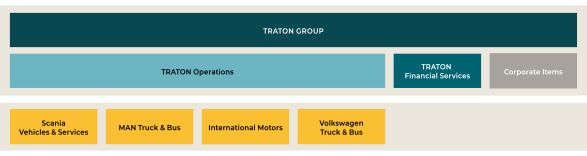
The TRATON GROUP’s activities are divided into the industrial business (TRATON Operations) and financial services (TRATON Financial Services) business areas. The TRATON Operations business area consists of the four segments Scania Vehicles & Services (brand name: Scania), MAN Truck & Bus (brand name: MAN), International Motors (brand name: International), and Volkswagen Truck & Bus (brand name: Volkswagen Truck & Bus — VWTB). The centralized activities of Group R&D are included in the TRATON Operations business area for accounting purposes.
Corporate Items contains the following items within the organizational structure and financial reporting:
- TRATON Holding (consisting of TRATON SE and its investees not allocated to specific segments),
- consolidation effects between the business areas as well as with TRATON Holding,
- and the effects of purchase price allocation from the acquisition of individual segments are summarized under Corporate Items.
2. Research & development
The TRATON GROUP aims to drive forward the transition to sustainable transportation with its investments in research & development. The TRATON Modular System (TMS) plays a central role here. The TMS will also increasingly be a catalyst for commercial success because it supports efficiency and global scalability. This strategic approach ensures versatile, efficient solutions and enables the TRATON brands to deploy competitive innovative technologies. The heart of this approach is the development of modular components with universal applicability across brands and applications. This approach reduces complexity, streamlines product development and is thus a significant driver on the road to sustainable transportation solutions.
The integration of significant parts of the R&D departments of the individual brands into a cross-brand organization was completed on June 30, 2025, with the result that Group R&D was able to commence operations on July 1, 2025. This saw the TRATON GROUP reach a strategic milestone. Approximately 9,000 employees from the research and development departments of the TRATON brands Scania, MAN, International, and VWTB are now working under the umbrella of Group R&D. As a result, there was a change in the Group management of the TRATON GROUP, which impacts segment reporting. This change is described in detail in the Financial management section.
The TRATON GROUP not only focuses systematically on innovation, but also on harmonizing product modules and securing different performance steps. In addition, the company is making substantial investments in forward-looking key areas, such as electrification and autonomous driving. In this context, expenditures of more than €2.4 billion are planned for the years from 2026 to 2030.
Since July 1, 2025, Group R&D has focused its research and development activities on the TRATON Modular System and related components projects. These include electric drives, the next generation of electrical/electronic architecture (E/E architecture), and compliance with future emissions legislation such as the Euro 7 and EPA 2027 emissions standards for the Group-wide 13-liter powertrain. In addition, Group R&D and US software company Applied Intuition, a vehicle software provider based in Silicon Valley, have started working together to build a software platform for all of the Group’s brands. The aims are to develop software-defined vehicles and introduce digital innovations more quickly and efficiently.
Scania’s research and development activities in 2025 continued to focus on electric mobility. Scania also invested in the expansion of the R&D department in China. In the future, vehicles will be offered that are specifically tailored to Chinese market conditions and customer requirements. In November 2025, Scania unveiled the new NEXT ERA series in China, a locally developed truck platform for long-haul transportation. AI-based systems have proven the performance of self-driving trucks and demonstrated their precision and safety. In parallel, Scania is driving forward the introduction of autonomous solutions for hub-to-hub transportation and mining — a crucial step towards more efficient and sustainable transportation solutions.
MAN’s research and development activities in 2025 focused on truck electrification, including the continued development, integration, and type approval (homologation) of battery technology in production-ready battery-electric vehicles, as well as the 2028 model year for the next generation of trucks. Work also continued on the TRATON Modular System and the development of the Euro 7 emissions standard for the D08 diesel engine.
International’s R&D expenditure in 2025 focused primarily on optimizing the Class 8 truck product range, more advanced safety systems, and connectivity features. However, work on the electric regional transportation project was discontinued and development of the next generation of battery-electric vehicles was terminated in order to align the future product portfolio with market requirements and regulatory conditions.
In South America, VWTB focused its research and development efforts in 2025 primarily on projects to meet statutory requirements and an expanded technology package for the truck series.
Research & development in figures, TRATON Operations
| € million | 2025 | 2024 | Change |
|---|---|---|---|
| Primary R&D costs, TRATON Operations1 | 2,731 | 2,456 | 276 |
| of which capitalized development costs1 | 1,215 | 976 | 239 |
| Capitalization ratio (in %)1 | 44.5 | 39.7 | 4.8 pp |
| Amortization of, and impairment losses on, capitalized development costs | 620 | 530 | 91 |
| Research & development costs recognized in the income statement | 2,137 | 2,010 | 127 |
| Sales revenue, TRATON Operations | 42,536 | 46,182 | –3,646 |
| R&D ratio (in %) | 6.4 | 5.3 | 1.1 pp |
| R&D employees (as of 12/31) | 12,411 | 12,527 | –116 |
1 The previous year’s figure was adjusted to the current presentation, see the Combined Management Report section Financial management.
3. Financial management
Internal management process within the TRATON GROUP
The TRATON GROUP is included in the Volkswagen Group’s internal financial management process. The starting point for the TRATON GROUP’s internal management is medium-term planning, which is prepared once per year over a period of five years. The core of the planning includes the long-term unit sales plan, the product program, and the capacity and utilization planning for the individual sites. The TRATON GROUP’s financial medium-term planning comprises the income statement, cash flow and balance sheet planning, profitability and liquidity, as well as investments.
The first year of the medium-term planning period is then fixed and a budget drawn up for the individual months at the level of the operating cost centers. The budget is reviewed each month to establish the degree to which the targets have been met. Important control tools are target/actual comparisons, prior-year comparisons, variance analyses, and, if necessary, action plans to ensure budgetary targets are met. For the relevant current fiscal year, detailed revolving forecasts for the full year are made based on the reporting in February, May, August, and October. These take into account current risks and opportunities. The focus of intra-year internal management is on measures for quickly adapting operating activities. At the same time, the current forecast serves as an ongoing, potential corrective to the medium-term and budget planning that follow on from it.
The merger of significant parts of the research and development departments of the individual brands into a cross-brand, Group-wide research and development (Group R&D) organization was completed as of June 30, 2025. This required a change in the TRATON GROUP’s Group management, which impacts segment reporting. The number and designations of the segments remain unchanged. The change impacts capitalized development costs, expenses, and intercompany income incurred and generated in cross-brand research and development.
Until June 30, 2025, cross-brand R&D projects were assigned to one segment and R&D expenses were recharged to the other segments that benefited from this research and development in the usage phase by means of licenses. Since July 1, 2025, cross-brand R&D projects have been recorded primarily on a centralized basis. Intercompany R&D expenses and income arising between Group R&D and the segments are now eliminated for segment reporting purposes. R&D expenses and capitalized development costs in Group R&D that are not eliminated are allocated to the segments in the TRATON Operations business area that benefit from the development project in accordance with predefined principles.
To ensure comparability, the corresponding prior-year figures for the individual segments were restated accordingly. The following table presents the resulting impact on sales revenue, operating result (adjusted), operating return on sales (adjusted), and investments for the period January 1 to December 31, 2024. Note that the impact on the Scania Vehicles & Services segment is also attributable to the fact that this segment played a leading role in research and development within the TRATON GROUP prior to the change. There is no impact on the TRATON Operations business area as a whole.
2024 comparative figures restated due to R&D reorganization
| € million | Scania Vehicles & Services | MAN Truck & Bus | International Motors | Volkswagen Truck & Bus | ||||||||
|---|---|---|---|---|---|---|---|---|---|---|---|---|
| 2024 | Change |
2024 (adjusted) |
2024 | Change |
2024 (adjusted) |
2024 | Change |
2024 (adjusted) |
2024 | Change |
2024 (adjusted) |
|
| Sales Revenue | 18,907 | – | 18,907 | 13,732 | –81 | 13,652 | 11,116 | – | 11,116 | 2,918 | – | 2,918 |
| Operating result (adjusted) | 2,666 | 135 | 2,801 | 985 | –66 | 919 | 791 | –66 | 724 | 349 | –3 | 346 |
| Operating return on sales (adjusted) (in %) | 14.1 | 0.7 | 14.8 | 7.2 | –0.4 | 6.7 | 7.1 | –0.6 | 6.5 | 12.0 | –0.1 | 11.9 |
| Investments | 1,487 | –100 | 1,387 | 631 | 68 | 699 | 571 | 32 | 603 | 92 | – | 92 |
Most important key performance indicators of the TRATON GROUP
As in the previous year, the following most important key financial and nonfinancial performance indicators were defined for the TRATON GROUP and the TRATON Operations and TRATON Financial Services business areas during fiscal year 2025:
| 2025 | |||
| TRATON GROUP |
TRATON Operations |
TRATON Financial Services | |
| Unit sales | x | x | – |
| Sales revenue | x | x | – |
| Operating return on sales (adjusted) | x | x | – |
| Net cashflow | – | x | – |
| Primary R&D costs | – | x | – |
| Capex | – | x | – |
| Return on equity | – | – | x |
In order to focus on the key control elements and reduce the complexity of our reporting, we have decided not to list the key performance indicators Primary research and development costs and Capital expenditures as the most important key performance indicators, but as additional performance indicators, starting in fiscal year 2026. As a result, no forecast for fiscal year 2026 is provided for these performance indicators in the Report on Expected Developments.
Unit sales
Unit sales represent the number of vehicles sold by Scania, MAN, International, and VWTB. They reflect the demand for our products and are decisive for the development of sales revenue.
Sales revenue
Sales revenue reflects our market performance in financial terms. For the segments within the TRATON Operations business area, it is based in particular on unit sales of new and used vehicles and on sales of spare parts and customer services. Sales revenue is also generated by the rental and leasing business and by interest from the financial services business in the TRATON Financial Services segment.
Operating return on sales (adjusted)
Operating return on sales (adjusted) is the ratio of operating result (adjusted) to sales revenue and expresses the economic performance of our business activities after accounting for the use of resources. Operating return on sales (adjusted) measures the TRATON GROUP’s profitability.
Adjustments are made in order to ensure the greatest possible transparency of our business performance. The adjustments to operating result concern certain items in the financial statements that, in the opinion of the Executive Board, can be presented separately to enable a more appropriate assessment of financial performance. They include, in particular, costs of restructurings and structural measures as well as one-time events with a material impact on the TRATON GROUP’s earnings.
Net cash flow
Net cash flow in the TRATON Operations business area comprises net cash provided by/used in operating activities and net cash provided by/used in investing activities attributable to operating activities and indicates the excess funds from operating activities in the reporting period.
Primary R&D costs
Primary research & development costs in the TRATON Operations business area contain both capitalized development costs (excluding capitalized borrowing costs) and research & development costs not eligible for capitalization. They represent expenditures ranging from futurology down to the market-ready development of our products and services. Calculation of the primary research and development costs in the TRATON Operations business area was adjusted so that the capitalized development costs included are now recognized net of the capitalized borrowing costs. The prior-year figure was correspondingly adjusted.
Capital expenditures
Capital expenditures in the TRATON Operations business area represent the TRATON GROUP’s investments in the future. They consist of the cash investments in property, plant, and equipment and in intangible assets (excluding capitalized development costs) that are reported in the statement of cash flows.
Return on equity
For the TRATON Financial Services business area, return on equity describes the profitability of the capital employed. It is calculated as the ratio of earnings before tax to average equity. Average equity is calculated from the equity at the beginning and the end of the reporting year. If calculated during the year, earnings before tax for the period in question are extrapolated to the full fiscal year on a straight-line basis.
Additional key performance indicators of the TRATON GROUP
In addition to the most important key performance indicators, the following additional performance indicators are defined for the TRATON GROUP or for the individual business areas or segments:
Capitalization ratio
The capitalization ratio is defined as the ratio of capitalized development costs (excluding capitalized borrowing costs) to primary research & development costs. It indicates which proportion of primary research & development costs is required to be capitalized. Calculation of the capitalization ratio in the TRATON Operations business area was adjusted such that capitalized development costs are no longer included.
Incoming orders
Incoming orders are defined as legally effective, binding orders.
BEV unit sales ratio
The ratio of the number of battery-electric vehicles and fuel cell electric vehicles to the total number of vehicles sold, excluding the MAN TGE model.
Book-to-bill ratio
The ratio of incoming orders to unit sales.
Gross margin
The gross margin is calculated as the percentage ratio of gross profit to sales revenue for the period in question.
EBITDA (adjusted)
EBITDA (earnings before interest, taxes, depreciation, and amortization) reflects operating performance before interest, taxes, depreciation, and amortization, after accounting for the use of resources. Since depreciation and amortization may depend on the chosen accounting policies, the carrying amounts, the capital structure, and the way in which an asset was acquired, EBITDA (adjusted) is used as a key performance indicator for peer group comparisons, in particular. Adjustments to operating result are also taken into account in determining EBITDA (adjusted). EBITDA (adjusted) is calculated for the TRATON Operations business area including Corporate Items, as it is taken into account for the calculation of the net financial debt/EBITDA (adjusted) ratio for the TRATON Operations business area including Corporate Items.
Equity ratio
The equity ratio indicates the ratio of total equity to total capital. For the TRATON Operations and TRATON Financial Services business areas, it is calculated from the perspective of the business area in question.
R&D ratio
Ratio of primary R&D costs to sales revenue.
Net liquidity/net financial debt
Net liquidity or net financial debt is calculated as gross liquidity, meaning cash and cash equivalents, marketable securities, investment deposits, and loans to affiliated companies (incl. restricted cash), less third-party borrowings (noncurrent and current financial liabilities). It reflects cash and cash equivalents, marketable securities, investment deposits, and loans to affiliated companies not financed by third-party borrowings.
Net financial debt/EBITDA (adjusted) ratio
The net financial debt to EBITDA (adjusted) ratio is calculated by dividing net liquidity/net financial debt by EBITDA (adjusted) for the past twelve months and is determined for the TRATON Operations business area, including Corporate Items.
Operating result (adjusted)
Operating result (adjusted) is calculated to ensure the greatest possible transparency of our business performance by making adjustments to our operating result. These adjustments concern certain items in the financial statements that, in the opinion of the Executive Board, can be presented separately to enable a more appropriate assessment of financial performance. They include, in particular, costs of restructurings and structural measures as well as one-time events with a material impact on the TRATON GROUP’s earnings.
Capex ratio
The capex ratio indicates the ratio of capital expenditures to sales revenue and is calculated for the TRATON Operations business area.